First Look
Dishonored
the tabletop RPG
ludique · First Look · mercredi, 25 mars 2020 à 15:58:36 · 14 min
To everyone's surprise, Modiphius announced at the beginning of the year the production of a tabletop role-playing game based on Dishonored, a license until then mostly confined to its medium of origin: the video game. We were expecting a release in mid-year, close to summer, but here is the English publishing house surprising us again by releasing its baby in the first days of spring, perhaps to offer the locked-down people we are a bit of reading while waiting for the end of this dreary period. For the occasion, the company's game designers decided to offer a narrativist version of their sacrosanct "2D20 System". An ambitious promise, considering that its mechanics are often considered very simulationist and "crunchy".
The role-playing game as a derivative product sometimes results in critical successes. Who would have believed that Star Wars D6 would give birth to what we know today as "Star Wars Legends"? That James Bond 007 would revolutionize narration mechanics in role-playing games? Is Modiphius's work on the Conan license not a stunning love letter, on top of a bible of references for the fans of Howard's original tales? Not to mention the often admirable work on the various adaptations of The Lord of the Rings. Alas, for each of these examples, one can mention as many that offer no other particularity than fan service. They are quickly forgotten, despite sometimes interesting ideas, but often under-developed.
The Discworld role-playing game, an example of a well-made licensed role-playing game that we really want to love, but whose value fades far too quickly.
So, the question of the day: what wood is this good Dishonored: the Roleplaying Game made of?
Dishonored, the license
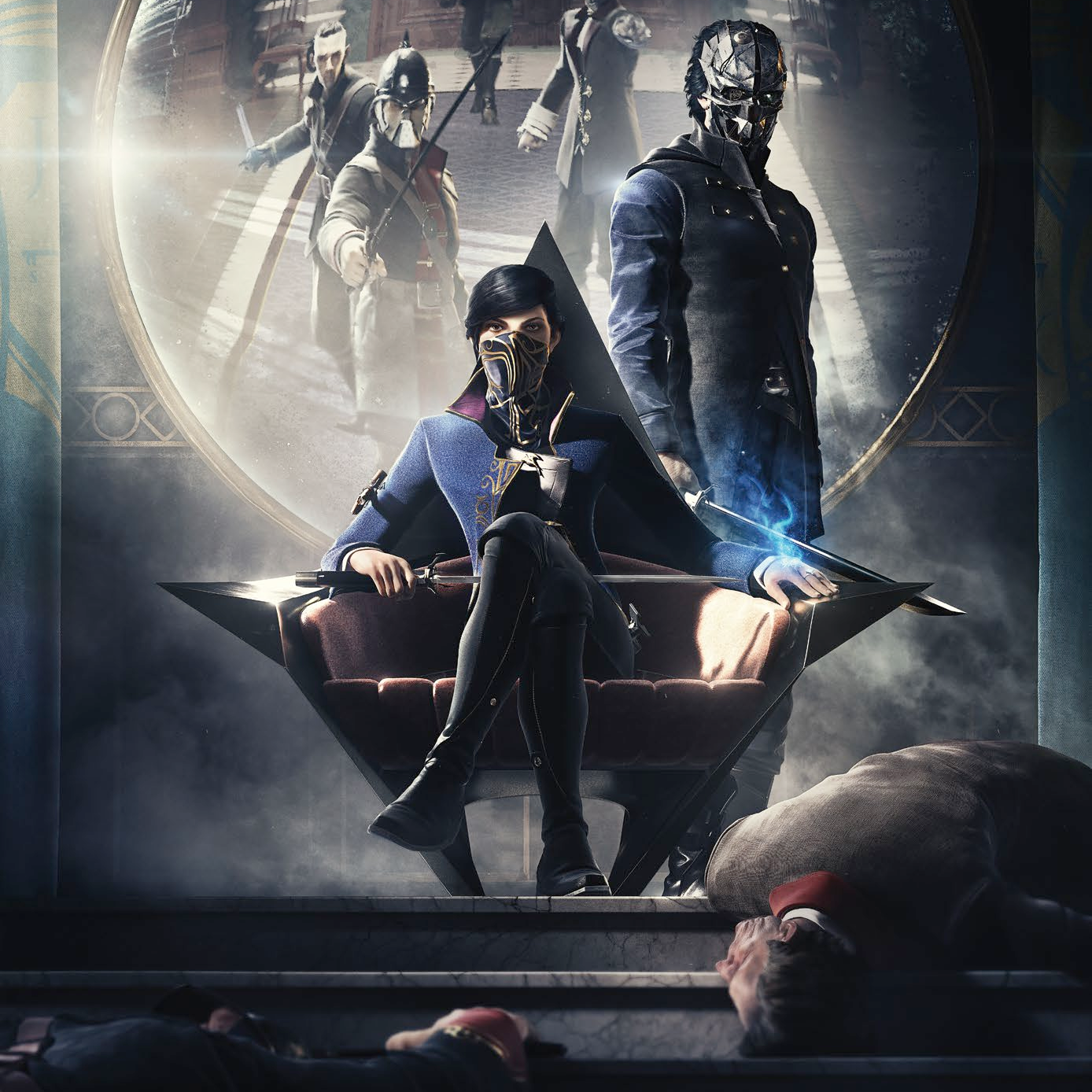
Dishonored is first of all two video games developed by Arkane Studios, the specialists of the "immersive sim". You play a disgraced protagonist, who tries to foil a plot across a succession of open levels, where freedom of action is king: objectives can be reached in very diverse ways, letting you either experiment with crazy ideas, or favor a preferred approach across the whole title. Beyond disgrace, the themes of Dishonored revolve around corruption in our societies, in particular the one emerging from class conflicts, as well as the temptation of occult powers to achieve one's ends. Another recurring point across the whole work, morality plays an important role: give in to your desires for revenge and murder, and the whole society will collapse in your wake. Defend human, positive values despite the injustice that struck you, and you will end up with consensual solutions where everyone finds their happiness.
Beyond the gameplay, Dishonored is also synonymous with an art direction to die for. Every face is a mine of details, every shot deserves a few minutes of contemplation. Guarantees of exoticism, the two main cities, Dunwall and Karnaca, are respectively inspired by England / Northern France and Spain / Southern France, in an industrial era. Mindful of these themes, the Modiphius team worked on a "tabletop" adaptation respectful of Dishonored.
The form
Pandemic obliges, the physical books of Dishonored: the Roleplaying Game will only reach us... "later". As things stand, I can only speak of the PDF, but its layout suggests that the physical book has a "pocket" format far more practical than the thick bibles that publishing houses too often grace us with. Let us be clear, I love copious volumes, but the fact remains that they impose too many constraints on reading. The game offers 313 pages (308 of text) generously spaced, which more likely correspond to ~150 pages in a traditional format. Yes, the content is not exceptionally copious, but its presentation convinces very quickly: no unwelcome eccentricity in the typeface, elegant decorations that pick up the graphic elements of the games, illustrations too rare, but evocative. There really should have been more of them to illustrate each archetype and, more systematically, each district of the two main cities.
We lose quite a bit of space, granted, but the book's visuals are respectful of the license's standards, and the text reads fast and well.
Bought yesterday, the book simply did not leave my hands, offering me my first one-sitting read in a long time. In comparison, the three latest Legends of the Five Rings supplements are still waiting for me to get past ten pages of consecutive reading...
That said, the text is not free of flaws. While it is easy to read, it also suffers from many typos, a lack of proofreading that tends to indicate a too-early publication, as well as certain questionable sentence structures, even for a "non-native English speaker" like me. Come on: Modiphius will no doubt have the opportunity to correct course before the physical books are printed, at least regarding the scattered typos.
The game mechanics
Like so many other publishing houses, Modiphius has a "flagship" game system declined for practically all its in-house creations. The famous "2D20 System" rests on two recurring concepts: its action resolution mechanic and its Momentum / Doom Points system. The mechanic consists of rolling two D20s (hence the system's very original name) and comparing each result to a skill level. Dice whose score is lower than or equal to said level generate a success, which can be doubled if the score falls below a "focus" value representing the character's level of expertise. All successes exceeding the number required to succeed at an action offer "Momentum" points that can be spent to add dice to a later roll, or to trigger other positive effects. Conversely, the GM has a number of "negative" points she can use to put obstacles in the PCs' path. Beyond that, all Modiphius games have a plethora of complex, often simulationist sub-systems. These earn them a certain depth, but also the reputation of being heavy. Many RPG players passed on these games in the face of this complexity.
In Dishonored, the team decided to migrate to the other end of the spectrum, that of narrativism, in a version renamed "Momentum System" depicted over a good sixty pages. The watchwords: fluidity, lightness, emphasis on character interpretation. Thus, a character is composed of six very broad skills, accompanied by six attitudes describing the approach a character can take to resolve a situation (careful, bold, etc.). A PC also has a number of "truths" - facts about them, which can play in their favor or against them - that the player freely describes in a few words. Finally, "expertises" ("focus" in English) complete the portrait, in the form of classic skills (firearms, negotiation, etc.) that determine the threshold below which a success counts double. The basic mechanic of Dishonored is therefore narrativist for two reasons: the use of an attitude must be justified by the player's interpretation, and the use of truths to reduce or increase the difficulty (number of successes required for a roll) is freely discussed with the GM. That is the base. Alongside this, Momentum and Chaos (the Dishonored version of Modiphius's Doom Pool) make it possible to impose "truths" on objects or characters (an exposed beam that allows an easier climb, a wound that slows a character down rather than simply injuring them). As for the inevitable magic, it takes three forms:
- Bone charms, small trinkets that grant specific bonuses (dice rerolls, creation of truths, etc.);
- The powers of the Void, granted by the mysterious Outsider. There are a good twenty powers, active and passive;
- Artifacts, objects of all shapes that usually contain a single power of the Outsider.
To conclude, I note another originality of the system regarding its handling of stealth. Since the video games give pride of place to infiltration, the Modiphius team proposes to use "vigilance gauges" that fill up little by little, as the PCs fail, until the moment the general alarm rings. Enough to give a bit more body to these tense scenes, rather than resolving them with a single die roll. However, I would have liked the system to be described in more detail, as it leaves the GM a huge margin of interpretation.
Fans will appreciate finding technical profiles of a dozen characters from the video games. Even the Outsider's, whose value is not really obvious in the case of a God...
On reading, the system of Dishonored enthuses me: I can clearly see how it will be able to spark a rich interpretation of the characters, but it keeps a minimum of "crunch" that should keep on their toes the players who want to invest themselves in their character's technical progression. Having read quite a few narrativist systems, however, I find that the one of Dishonored lacks a hair of identity, and this detail could play tricks on it commercially: for many narrativist RPG players, why bother learning a new system when they already master one perfectly? I also foresee a few aspects that could take the system from "good" to "good... on paper", such as a very high mortality, involuntary omissions that here too testify to a rushed release (the crunch fans mention the absence of stress recovery rules, for example), or risks of imbalance, notably with the Outsider's powers. As often, we will have to wait for a test on the table to confirm or deny these fears!
Let me close my grievances on the system with character creation. Too expeditive, it is limited to selecting two truths, an archetype among the 13 offered, and a few rather restricted options within that archetype's frame. This selection-based approach works well with the traditional games of the "2D20 System", because a character there is composed of a succession of "layers" whose many combinations guarantee varied results (childhood, adolescence, adulthood, profession, war experience, etc.). With the "Momentum System", things are unfortunately different, and only the "truths" will allow differentiating a character considerably from their peers.
The setting
Dishonored offers to play in a fairly broad time frame, going from the premises of the first game to the end of the second, i.e. a good twenty years loaded with events. The book moreover offers a series of scenario hooks for every object it describes, be it a character, a faction or a location. The setting's presentation thus looked promising, but let us not beat around the bush: it is sorely lacking. The timeline offers no real information on the founding of the Empire of the Isles, nor on the centuries preceding it. Your characters will therefore have no way to learn more about the history of the Empire they live in, unless of course the GM takes liberties, even if it means contradicting potential future publications on the subject. Even more annoying, the description of the factions is limited to one full page each, half of which is devoted to their internal hierarchical ranks. For instance, hard to understand the Abbey of the Everyman's dogma with so little information: you are brutish zealots, that is all. Zealots of what, if not "anti-supernatural purity"? Eh... refer to the game for that! Although mentioned several times, the Seven Strictures are not even enumerated once in the whole book!
The descriptions of Dunwall and Karnaca save the furniture a little, each district being described with about as much content as the factions. The history of these districts partially compensates for the famine on the factions, by concretely illustrating how they interacted during the crises the two cities went through. On the other hand, do not hope for other maps than the two cities' general ones: you will have to invent shops, inns and so many other locations that will allow the PCs to evolve in a living world. Finally, the presentation of the two provinces that no game has yet explored, Morley and Tyvia, as well as that of life at sea, bring a few interesting leads for small intrigues or exotic appendices to a campaign in the two main cities. Unsurprisingly, they unfortunately also prove too light to serve as a dedicated framework, without making considerable efforts to enrich them.
A 30-page scenario concludes the book. Two words come to mind: originality and linearity. The whole thing starts from bases very far from the "one-size-fits-all" scenario generally found in core books, but the unfolding presented in its paragraphs leaves little room for improvisation and the players' ideas: not only do the authors really encourage the GM to steer the PCs in the desired direction, but they offer no game aid able to develop alternatives on the fly (no map or description of the locations, for example). Here again, we will have to work to compensate for these weaknesses, even though it seems more common (and acceptable) to rework a scenario than a whole setting.
Dishonored fails badly across its entire game context. Yet, the content seems to be there, and I hardly know how to explain why it seems so little usable as is. Maybe it would have been better to focus on Dunwall alone, along with its factions, rather than flying over all the content produced for the franchise in a core book that is too thin. On a positive note, the authors have fortunately taken to heart the themes dear to Dishonored, and many scenario hooks highlight the class struggle and the moral corruption the protagonists must beware of. Failing to be sufficient, the information provided in the core book does not distort the games' message, with the notable exception of the scenario, which twice favors murder (the games always insist on the existence of peaceful options, even if they are sometimes hard to reach). For a derivative product, that is already a good thing.
Despite my sympathy for the project, I fear Dishonored: the Roleplaying Game will struggle to go beyond the frame of the video game's fans looking to immerse themselves in the license's universe. Its ludic mechanics appear to me as entirely solid and interesting, but the narrativism fans will hardly be disoriented. The collecting bug could however push them to take the plunge. On the other hand, the "crunchy" game fans will understand nothing of it, as many comments on the forums (Modiphius's, or RPG.net's) illustrate. As for its universe, it is exposed far too succinctly and incompletely for one to fully dive into it, despite the promising themes. If Modiphius does not considerably develop the line, with quality context supplements, Dishonored may well be nothing more than a pleasant publication, quickly drowned in the rich RPG landscape. A pity, for the game remains good all the same, and clearly does not deserve the dishonor of oblivion.
EDIT July 15, 2020: after receiving the definitive version of the game, I discovered with joy that the authors added a layer to character creation. "Outlook" allows choosing a major character trait, from which follow characteristic modifications and new talents tied to your choice. This new option offers a bit of nuance to the too-rigid character creation of the game's first versions. Other modifications were made to rules details or to the linguistic style, a very appreciable proof of good will from Modiphius!
The illustrations in this article are the property of their respective rights holders, namely Bethesda Softworks (parent company of Arkane Studios) and Modiphius Entertainment.