First Look
Call of Cthulhu
7th Edition
ludique · First Look · samedi, 26 décembre 2015 à 14:12:37 · 11 min
After months of (more or less) feverish waiting, the latest edition of "Call of Cthulhu" is finally in my hands. Several quick reads through the books have allowed me to form a first opinion of this new version, particularly regarding the rules. In 2013, our group had indeed decided to turn the page on the "Call of Cthulhu" game system in favor of the "Gumshoe" of "Trail of Cthulhu" ("Cthulhu", in French). A reconciliation to be expected? Not sure...
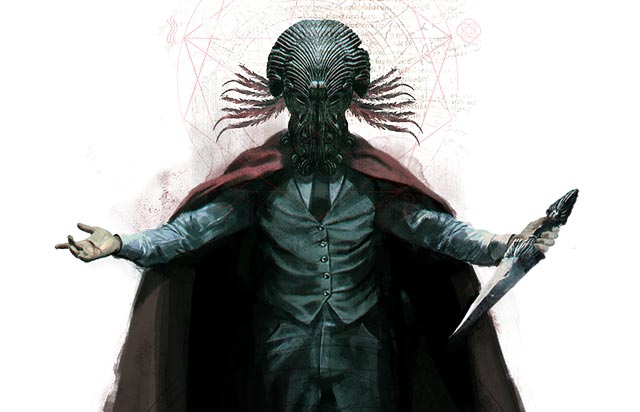
The cover illustration is by Loïc Muzy, for éditions Sans-Détour.
This post is a first look, not a "test" or a review. Not having been able to try this new system in the field yet, my opinion is purely theoretical. To be taken with a grain of salt.
The Context
I won't insult you by contextualizing, once again, this grandfather of tabletop RPGs that is "Call of Cthulhu". Let's settle for the basics needed for this article: in its original version, "Call of Cthulhu" is published by "Chaosium", one of the oldest tabletop RPG publishing houses. It is in charge of the "Basic Role-Playing" game system (BeRP BRP in the rest of this article), which has powered "Call of Cthulhu" for more than thirty years and whose first application dates back to RuneQuest in 1978. The French version, for its part, was published successively by "Jeux Descartes" until 2005, then by "éditions Sans-Détour" since 2008. When Sans-Détour published the sixth version of "Call of Cthulhu" in 2008, a few changes were made compared to the original version dating from 2004: among others, the choice of play style and the aplomb points.
After years of gestation, the seventh version of "Call of Cthulhu" came into being between 2014 (English) and 2015 (French). The publication of the English and French books is supported by two crowdfunding campaigns — one for Chaosium, the other for Sans-Détour. These sums of money allow the publishing houses to take great care of their game materials, providing a quite extraordinary slew of goodies. I followed the Chaosium kickstarter only loosely, but the Sans-Détour campaign rubbed some people the wrong way: not only did the publishing house have enough money to fund its project itself, but it also deprived many shops of sales by offering the game directly to thousands of backers. Not content with a first campaign that was largely crowned with success, the Sans-Détour team went at it again for the publication of "5 Supplices", its first original campaign ((The other campaigns are translations, often enhanced with welcome scenarios and play aids.)). An opportunity to correct certain moral missteps of their first attempt, by adding offers aimed at shops. Personally, I had always hoped to see their team embark on such a project, knowing the very good dusting-off work done on "Masks of Nyarlathotep". On the other hand, a certain toxicity emanates from the proliferation of crowdfunding in the tabletop RPG world: backers are poorly protected against projects' "hiccups along the way" (the second edition of Pavillon Noir is an excellent example), and those who keep their distance are de facto punished for not having jumped on the train before it even entered the station. Perhaps these fundraisers should be reserved for projects that could not, in any case, see the light of day without the crowd's help?
Alright. Enough controversy about the funding of this new edition of "the Call".
Form
Let's start with the game's presentation. After all, many roleplayers have a collector's soul, all the more since a pleasant layout makes reading easier (whether before or during a game session). Sans-Détour has accustomed us to quality: while the pages of most of its books are in shades of gray, the publishing house has never spared its efforts to offer a pleasant structure in which the information you're looking for is easy to find. As an exception, the 30th anniversary edition of Call of Cthulhu even came out in color, with an embossed cover. I would have liked something similar to celebrate this seventh edition, but Sans-Détour preferred to invest in the goodies and the supplementary books of the "Prestige" version, reserved for the wealthy backers of the crowdfunding. Too bad for everyone else? So be it.
Contents of the "Prestige" edition: a magnificent cardboard box, a slew of supplementary books, more play aids than you know what to do with. And above all, a digital version of the books, so they can be consulted more easily during games. The visible illustrations are by Loïc Muzy.
The inside of the books is relatively faithful to Sans-Détour's habits: solid layout and pleasant, readable text. Also noteworthy: a quality translation. I have no memory of coming across a single mistake. The photographs, on the other hand, leave something to be desired. While I prefer atmospheric photos a thousand times over the B-movie images of the original version, the recycling of certain portraits used in previous books and their sometimes sloppy processing clash with the professionalism of the whole. To better understand what I mean, take a look at this floating illustration on page 114, rather clumsily cut out from a photo on page 94. While my eye wasn't really bothered while reading the physical book, the digital version accentuates these flaws.
Ouchi...
I hope I'm not giving too negative a picture of the work done by Sans-Détour on this new edition. Not only did I enjoy the read, but the quality of the result must also be saluted compared to the original version, which seems stuck in the 80s (that might be intentional, mind you).
Cover of the original version of the game, by Sam Lamont for Chaosium.
Layout of the 7th edition English demo kit. Let's grant it one thing: the text is readable...
One last thing: at my place, the Prestige edition's box arrived damaged. While the books inside were untouched (I was even spared the other content issues), receiving "prestigious" content damaged, months late, is on the edge of acceptable.
Substance
The separation between the "Keeper Rulebook" and the "Investigator Handbook" echoes "Dungeons & Dragons" and its rather unfriendly way of making us buy two books to create characters and run games. Here, nothing of the sort: the "Keeper Rulebook" contains everything needed to play (more than 400 pages), and the "Investigator Handbook" is, roughly speaking, an updating of the "Investigator's Manual" (2013) with some additional information about the organizations the characters can belong to.
Most of what follows deals with the "Keeper Rulebook", the equivalent of the core rulebook of previous editions. Here again, nothing disorienting for anyone who already owns the 6th edition of Call of Cthulhu:
- An introduction
- A presentation of H.P. Lovecraft and the genesis of the Cthulhu Mythos
- The character creation system
- The game system
- "Magic"
- Advice for the Keeper
- The Mythos tomes, grimoires and the bestiary
- Two scenarios
- Some fifty pages of appendices, including the return of Sans-Détour's 6th edition rules
Yes, it's practically the same as for the 6th edition, including that rather out-of-context emphasis on specific situations, like car chases. The game universe, too, has changed little. Feigning surprise would be hypocritical. Everything has already been said about Lovecraft and his cosmic-anxiety-inducing universe; the biggest difficulty is synthesizing it all correctly and in a fun way. On this front, the book does its job: the presentation of the universe is enough to get everyone up to speed, and the description of the Mythos creatures is of the same caliber as before (namely, a little too down-to-earth for my taste, but perfectly functional). Sans-Détour as always decorates the whole with a wealth of pleasant information and anecdotes about the historical context. In all this consistency, a few caveats tarnish the assessment:
- On the one hand, I get the feeling the game's atmosphere leans toward a bruiser mentality that fits poorly with Sans-Détour's usual publications. Right in the game's description: "They [the investigators] will track down, study and, ultimately, destroy the horrors, mysteries and secrets of the Cthulhu Mythos". Destroy the horrors, mysteries and secrets of the Mythos? Finesse and subtlety: the tone is set. This feeling of bruteness is further reinforced by the English-version illustrations, the emphasis on combat, and the ever-so-Cartesian descriptions of the Mythos creatures.
- As Batronoban, a reader and reviewer on Legrog.org, has pointed out, the authors still avoid criticizing Lovecraft for some of his unwelcome ideas that are sometimes hard to separate from the game (omnipresent racism and sexism).
In short, nothing has really changed there. Call of Cthulhu remains Call of Cthulhu.
Our group dropped BRP in favor of Gumshoe during the Masks of Nyarlathotep campaign, after the 8th death of a PC during a not-so-thrilling sequence — the excuse of the "Lovecraftian death" therefore didn't hold. Gumshoe gives players almost total control: they invest their points according to their intuition and depend very little on dice rolls.
I would have liked to say something else about the game system, but the conclusion is inescapable: here too, it's broadly the same. For the most part, the changes go in the right direction. Beyond the cosmetic modifications (characteristics are now rated on a scale of 100), the clarifications on levels of success and opposed rolls are relevant. Thus, instead of endlessly rolling opposed checks between PCs and NPCs, most opposed situations are resolved by modifying the PCs' score according to the opponents' skill level. Sneaking into a museum will now require a single die roll, more or less difficult depending on the guards' vigilance. But the finest idea in this new edition is the "pushed roll", a mechanic that lets you try your luck again while taking greater risks. Some game tables already apply it instinctively: a player's first skill roll doesn't put them in danger. On a failure, their character simply realizes their efforts won't be enough to achieve the desired effect. Consequently, they can "push" and attempt the action again, with potentially more serious consequences. In the context of an infiltration, a first failure would mean the character realizes they won't manage to go unnoticed — before it's too late. If they decide to "push", they gain a new chance to succeed, but risk being detected. I like this system, because it strikes directly at BRP's weak point: the arbitrariness of the die roll. How many times have groups of PCs remained stuck because of a failed Library Use roll? While failure can give rise to interesting situations, it is just as frustrating when it needlessly deprives the players of an important lead or slows the session down on tedious details.
The "pushed roll" gives players more control, as they can more effectively gauge the risks they take. An adequate answer to BRP's biggest weakness, but not necessarily a sufficient one, since it doesn't apply in combat. At that level, arbitrariness still reigns. Sans-Détour has also relegated its own 6th edition modifications to appendices hidden in the depths of the book. The play styles made it possible to clarify, from the start, what atmosphere was expected during the session. As for the aplomb points, they gave players a minimum of control, sometimes avoiding an absurd death on a single failed roll. All of that moves to the background: it's up to the players not to ignore these rules.
This edition won't be enough to bring me back to the "Basic Role-Playing" system. I would rather adapt the "pushed roll" concept to Gumshoe. A missed opportunity, which I will nevertheless try to confirm during a one-shot in the coming months. As for the background information, I spotted nothing fundamentally new or relevant — though I wasn't really expecting any.
In the meantime, the future Keepers who want to dive into "Call of Cthulhu" can invest in this 7th edition with confidence: nothing can take away its generous, quality materials, its rules system that has proven itself with many groups, and its universe that remains as fascinating as ever. As for those who already own the older editions, the assessment is more nuanced. Either collector's fever wins out, in which case you can give in and get the Prestige edition, or your budget is tight and would be better invested in a campaign or a scenario.