Rules Example
Jackals
A demo fight
ludique · Rules Example · jeudi, 6 mai 2021 à 11:23:21 · 10 min
As a follow-up to the character creation, here is a second article presenting the unfolding of a "technical" scene typical of Jackals. Most role-playing games put the emphasis on action and, even more, on physical confrontations. Jackals being hardly an exception to this rule, I offer you a combat simulation between Amennekht and an emblematic adversary of the game.
- [Let's Create a Character] Jackals - where we create Amennekht
- [Rules Example] Jackals
- [Review] Jackals
In Jackals, every character is endowed with "Clash points" that determine their action potential. To prepare a balanced encounter, the GM is encouraged to compare the number of characters and their Kleos level (reputation, roughly, which grows with adventures) to the adversaries' number of Clash points. Alone and inexperienced, Amennekht will therefore only face a single enemy.
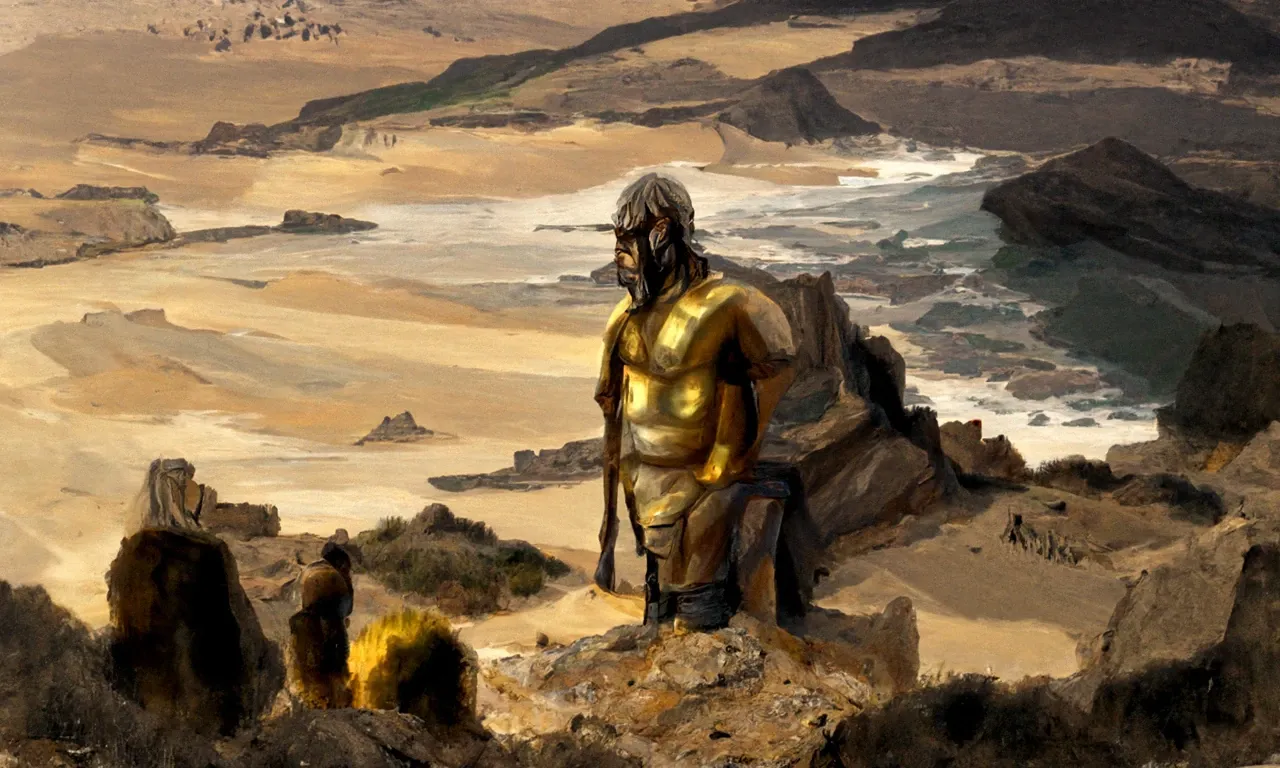
While traveling alone on the edge of the Vori Desert, Amennekht comes across a scene as picturesque as they come: a prospector, drawn like so many others by rumors of hidden riches in these forbidden lands, lies prostrate on the ground, frozen with terror a few meters away from an infamous Oritakan - one of the creatures that enslaved Gerwa's neighbors decades ago. No sooner said than done, Amennekht heroically steps in.
Unfolding
The Oritakan has 2 Clash points, while Amennekht has 5. The prospector, an ordinary NPC, is terrified: he will not react and only has 20 hit points. The stake would therefore be to protect him or, failing that, to slay the creature.
Initiative
Initiative is computed with 1d6 added to the character's deftness score.
- In the Oritakan's case: 6 (roll) + 15 = 21.
- In Amennekht's: 2 (roll) + 12 = 14.
The Oritakan therefore takes the lead.
Little piece of dumb information that made me waste some time: the book says to use "deftness" to compute initiative, but the NPCs' stat boxes rather use the term "initiative".
The Oritakan's attack
An NPC has an attack score, itself divided into different combat options. The higher the die result (and the closer it flirts with the NPC's skill ceiling), the wider the range of tricks available to the GM, since all options below the dice result are accessible.
The Oritakan therefore uses its normal movement to approach Amennekht, and attempts an attack.
- The dice return 57, the Oritakan has an attack skill of 60.
Nice roll! All options are on the table, and Amennekht would need a good roll to parry, should it come to that. Faced with this success, the GM chooses Flail of Ignorance to inflict damage: it is a double attack. If the first one lands, the Oritakan will automatically land a second one.
The Oritakan raises its flail as it advances towards Amennekht, the upstart having stepped between it and its target. Whipping the air, it brings the thick studded heads of its weapon down on the young Ger.
Ammenekht can spend a Clash point to defend himself. Since he has 5 points, using one to spare himself injuries is a no-brainer.
- His player rolls the dice: 33.
The attack succeeds and it is a critical, since both dice show the same number! In this case, Amennekht inflicts his weapon's maximum damage, which he boosts with two Clash points to add 1d6: 10 (weapon) + 6 (boost) + 4 (strength bonus). The Oritakan has armor that reduces the damage to 18, leaving it the tidy sum of 17 points.
Facing the threat, Amennekht answers with an offensive. He lunges, deflects the Oritakan's weapon arm with a powerful shove of his shield, then lands a violent Khopesh blow on the creature's shoulder, which staggers under the impact.
Amennekht's response
Ammenekht's main objective in this scene is to protect the prospector. To prevent the creature from attacking its initial target, Amennekht uses the "Taunt" action, triggering an opposed roll between his influence score and the adversary's defense.
- Amennekht: 48 / 76
- Oritakan: 87 / 70
A success against a failure: the Oritakan will therefore have to spend a Clash point to attack anyone other than Amennekht until the Ger's next turn. Theoretically, the perverse Oritakan could always spend one Clash point to move away from Amennekht by dodging his "opportunity" attack, then use another one to strike the prospector.
Amennekht seizes the occasion to take a step forward, puffing out his chest and glaring down his adversary. The Oritakan, doubled over in pain, straightens up with difficulty, cowering before the silent challenge thrown its way.
The Oritakan's second action
Oritakans are treacherous, so this one will precisely attempt to disengage in order to cut down the miserable prospector. Its turn therefore unfolds in two steps:
The disengagement. Seeing its adversary slip away, Amennekht naturally seizes the occasion to land a blow. The Oritakan spends 1 Clash point to be able to dodge.
- Amennekht gets 79 out of 87
- the Oritakan gets 19 out of 70
Despite its successful action, the creature suffers Amennekht's attack (higher result). It takes 1d10 + 1d4 damage points:
- 6 and 4
reduced by 2. Only 9 hit points remain for it.
The Oritakan carries on.
- The attack targeting the prospector: 40 out of 70.
The attack lands, and the Oritakan uses its Dance of Slaughter to inflict damage on Amennekht as well as the prospector. Since it is an NPC, the game recommends using "static" damage rather than rolling dice: 16 points. The prospector is at death's door, while Amennekht only has 28 Worth points left. When his points are entirely spent, he will start suffering serious wounds.
The strange Oritakan nimbly moves to Amennekht's left flank, accelerating at the last moment in the hope of outrunning the Ger. It is a lost cause: the man turns around and brings his Khopesh down on his sneaky adversary's back. That does not stop it, however. Shrieking with frustration, the Oritakan whirls its sinister flail, forcing a dodge
in-extremis
from Amennekht, as the weapon heavily falls on its true target: the prospector, whose ribs it fractures without mercy.
Just like that, it is hard to know whether the NPC's attack, which initially targeted the merchant, can be opposed by Amennekht when it turns into a multiple attack. In order to test the damage on the PCs, let us assume it cannot. But the question will remain open around a gaming table.
Amennekht's second action
The time for feints is over. Amennekht attempts an attack, which he fully intends to improve should it land:
- 100, the worst imaginable fumble!
Ammenekht's "Warrior Caste" trait however allows rolling two dice to determine the units, rather than one. His player rerolls: 10. Honestly... fate is relentless!
For lack of points, the Oritakan does not retaliate and unless I am mistaken, the rules do not really specify the impact of a critical failure in this situation. Page 114, for the Craft skill, however mentions that broken equipment inflicts a -2 penalty on its use: let us assume Amennekht broke his blade on a nearby rock.
Break out in a cold sweat - he who thought he had the situation under control! - Amennekht rushes at the Oritakan. In his haste, he slips on the sand as he delivers his blow. The fragile blade of his Khopesh hits a rock and whirls away, leaving the Ger with only the base of his sword - a vaguely sharpened stub - to defend himself.
The Oritakan's third action
Why stop on such a good path? The Oritakan doubles down and targets the prospector again - this time, without having to spend a Clash point.
- Result: 5.
According to the Oritakan's action table, it hardly has a choice: it lets out a Rallying Laughter, since these creatures are generally leaders rather than lone warriors. This demonic laugh lets it recover 1d8 hit points,
- that is, 6
, in this instance.
Its adversary's misfortunes, its prey's frailty, everything seems to line up perfectly for the Oritakan, which for a moment thought itself lost. Too sure of itself, it cannot repress a sinister snicker that confirms its position as alpha predator.
Amennekht's third action
Another round, another attempt.
- Amennekht strikes with his Khopesh: 5, here as well.
Suffice it to say that rejecting the units die could not yield anything good, once again. In response, the Oritakan reacts by spending a Clash point: it has strong odds of beating this score.
- 77, out of 60: the action fails.
Ammenekht then spends two Clash points to improve the damage by 1d6:
- Damage (1d10 + 1d6 + 1d4): 2 - 4 - 3
The result is mediocre, so much so that Amennekht uses his Destiny point to reroll the damage. This time, he obtains the impressive scores of
- 10 - 6 - 3
that is, 19 damage points, from which 2 are subtracted for the broken blade and 2 for the armor. The Oritakan takes 15 points... and collapses, since it had exactly that amount left. By the Eight, the fight is won!
It is a desperate gesture that ends the confrontation: seizing his chance, Amennekht delivers a blow that seems ill-fated, one the Oritakan however cannot outbid. With force, what remains of the broken blade passes through its target's throat, carrying its windpipe away in its wake. The monster feels its strength leaving it. It staggers for a few meters until its legs betray it, collapses to the ground, and falls asleep for eternity.
Impressions
Rather fast, quite open to tactics, readable in its probabilities, relatively clear in its functioning: judging by this first bout, the Jackals system aims to be rather reassuring.
The system's best idea is of course the Clash points, which remind me a bit of the Dark Earth system, while remaining less cumbersome (no "allocation phase" at the start of the round). For the players, the options offered by the allocation of these points provide better control over the fight. For the GM, the point will mostly be to threaten overconfident PCs and thus encourage them to drain the adversaries' Clash points first before attempting a risky attack. These options, coupled with the available actions, give the confrontations a good balance between "narration" and "gameplay". Another pleasant mechanic of the system lies in its handling of critical successes and failures, as well as the traits that allow rolling two dice for the units. Granted: in our example, we hardly got to enjoy them, but it truly is a double stroke of luck!
Without being the biggest brute in the world, Amennekht still benefits from 45 Worth points, followed by 18 wound points, while the Oritakan deals on average 16 damage points. At that rate, the Ger would have needed many rounds before falling. One can say the characters are rather well protected! That said, once Worth is exhausted, recovery seems relatively long. I imagine a wounded character can quickly become dead weight in a team lost in hostile territory. Note that NPCs are supposed to start fleeing when 50% of their number is down, so as to speed up fights, as well as to inspire players to do the same should their characters be in a bad position. In the end, only one aspect of the game proved awkward in this scene: the information is not always presented in a very structured manner, and the GM's arbitration will sometimes be needed to clarify certain rules points.