Review
Qin
The Warring States
ludique · Review · jeudi, 3 décembre 2015 à 11:41:06 · 11 min
After the write-up of a Wulin one-shot and the republication of our Tianxia campaign summaries, the time has come to deliver a review of "Qin - les Royaumes Combattants", from le 7ème Cercle. I hope you will find it enlightening.
2005 was a rather surprising year for RPG players in love with Wuxia Piàn. Until then, the roleplaying sphere had shown little interest in China as an exclusive playground: there were indeed several titles more or less inspired by Japan ("Bushido", "Legends of the Five Rings", "Sengoku"), at least one Kung-Fu system ("Feng Shui"), and supplements of generic lines vaguely interested in the Middle Kingdom. But never anything purely "Chinese", in the mechanics as much as in the atmosphere. It is in this ludic landscape that two French-language role-playing games about China and the Wuxia are born. Their names? "Qin - Les Royaumes Combattants" (usually called "Qin" in the rest of this article, even at the risk of causing some confusion with the eponymous dynasty) and "Wuxia" (which is simpler to write). On the good advice of Midori and following a short discussion on Au fil du jeu, I purchased Qin towards the end of 2005. Five years later, our group completed the official campaign offered within the game's line. This feat constitutes enough experience to cast an informed eye on this game.
Cover of the "Qin - les Royaumes Combattants" core book, from Éditions du 7ème Cercle. Illustration by Aleksi Briclot and "Florrent".
The Story
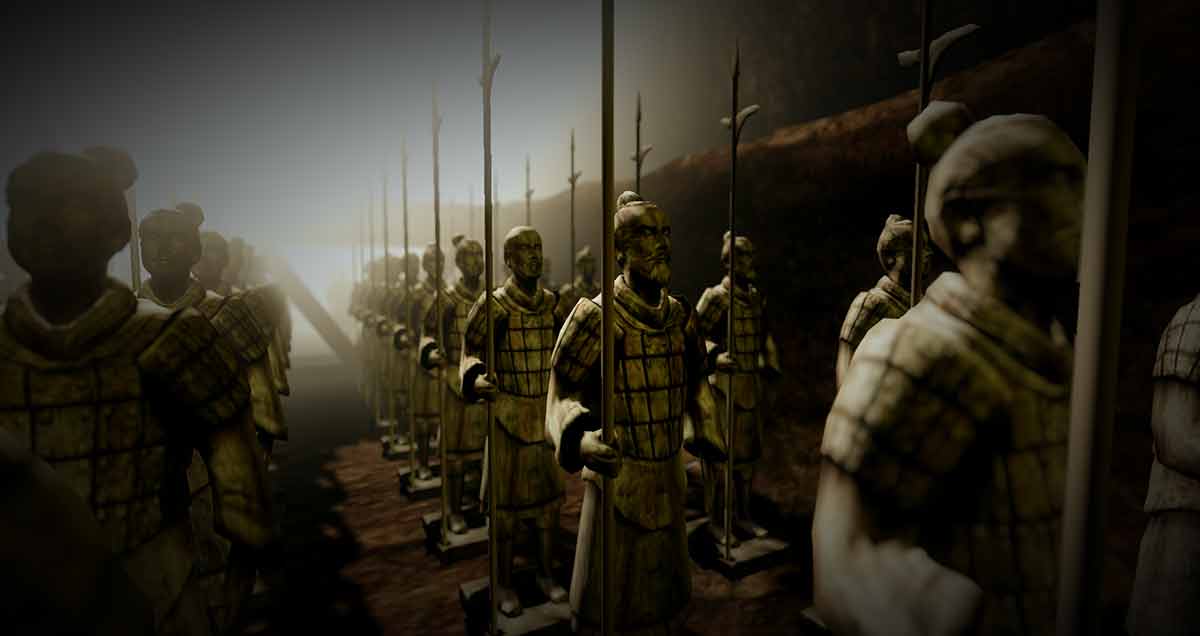
Originally, the "Qin" line was meant to offer different historical play settings. In the end, only two periods were covered - the "Warring States" (from ~500 to 221 BC) and "Shaolin & Wudang" (beginning of the Qing dynasty, 16th-17th century). Unsurprisingly, the first line concerns... the Warring States. At that time, the concept of "China" only existed very vaguely under the name "Zhongguo" [1]. This Zhongguo experienced an impressive intellectual effervescence, leading it to modernize at a dizzying pace under the impetus of its internal conflicts. In this context, the western kingdom of Qin stands out. Its territorial conquests follow one another, and soon, nobody can doubt its capacity to unify the lands of the former Zhou Empire. Between modernity and traditions, unification and diversity, the players portray heroes who must prove themselves, like every good Wuxia Piàn protagonist.
The core book and its supplements are mines of information. From architecture to the calendar, via the philosophies and the geography of the Chinese territory, the authors managed to paint a complete overview of the era's society without making it indigestible. Admittedly, questions will inevitably remain about how a society this distant from ours works, but the core book's content is amply sufficient to convey a convincing feeling. I just regret two things:
- The somewhat forced differentiation of the various kingdoms. To give colors to the Zhongguo, the authors clearly wanted to exaggerate certain cultural differences beyond reason (Qi = culture, Zhao = cavalry, Han = diplomacy, Wei = religion).
- Certain approximations. It seems to me (without being an expert on the matter) that certain customs and beliefs presented in the book only came to be after the Warring States.
The mechanics
On the rules front, Qin looks classic, fluid and deliberately light (as opposed to simulationism or complex systems). In truth, while fluidity and lightness are indeed present, one also notices a myriad of small details that allow the game to stand out. In my opinion, the strongest idea lies in the use of a differential between two D10s as the base for every test (a black die - the yin - and a white die - the yang). You add the result of the differential to the character's skill and attribute scores, with the goal of exceeding a "difficulty rating" (DR) generally set between 7 and 15. The use of the differential greatly reduces randomness, since the odds of obtaining a result of 1 are far greater than those of obtaining a 9. With skill + attribute pairs hovering around 7-8 for competent characters, the die's result has only marginal importance. When undertaking an action, a player knows more or less what to expect. She therefore stays at the helm of her character's destiny, although a surprise cannot be excluded. This surprise will generally be good - since doubles from 1 to 9 are more or less brilliant automatic successes. Then remains the fear of the bogeyman - the critical failure on a double 0 - whose low probability of appearance limits the impact.
To spice up the action a little, the characters have a reserve of Chi points that can be used either to activate heroic powers, or to improve the odds of success of a roll. Managing these points, which falls entirely to the players, is an interesting strategic lever. A Wuxia in top form can always secure the success of an action, at the cost of a few Chi points. Only once exhausted will he be at the mercy of fate. A bit like the Gumshoe system, the whole point is managing one's points, using them judiciously so as not to tire oneself out.
Something else. Let us not fool ourselves: for a non-negligible portion of RPG players, managing the evolution of one's character among a mountain of options, skills and numbers remains a rather thrilling experience. The D20 system's success is proof of that. Although light, Qin's mechanics nevertheless manage to preserve this feeling of power increase and personalization of one's hero, thanks to an honorable list of powers and play options. A harmonious blend of richness and simplicity.
Forgive me these additional flowers: Qin is a Wuxia game, hence a combat system that holds up its end. I remember a duel between two characters, described solely through the martial maneuvers offered in the rulebook. "He charges at you vigorously, shouting his war cry." "I perform a spinning parry to deflect his blade and turn it against him." "From the ground, I try to grab his legs to throw him down." Coming out of the fight, the players had witnessed a formidable joust without having consciously made the effort to describe their actions: using the wide array of possibilities of the system is enough to bring the tale to life, to sustain the narration. That is the whole finesse of Qin's system, which exceeded the merely functional to reach excellence without advancing any a priori revolutionary ideas.
Who loves well, chastises well. After all these compliments, I can only point a finger at the few limitations of the system encountered during our games. The most frustrating comes from the cost of skills: boosting one's fencing, Taoism or one's Tao scores offers advantages far superior to raising a "classic" skill. In both cases, the experience cost is identical. Many players gave in to the temptation of improving the characters' martial talents rather than investing in normal skills. This problem, raised many times on Qin's forums, was swept aside a bit too easily by the authors. For them, it was all a matter of roleplay: a player respectful of their character will make sure to assign the skills they deserve. They further insisted on the social recognition that mastering a skill can bring. In our group, I tried everything: roleplay, capping the maximal DR according to the skill score, assigning special abilities based on the skill level (à la Legends of the Five Rings), but nothing was truly conclusive. Either the mechanics were too heavy, or they hardly validated the players' investment in classic skills.
If I were to take up running Qin today, I would ask the players to think of a non-martial talent that characterizes their character: in the manner of "Broken Sword" in "Hero", they would first have to improve said talent before being able to cross certain thresholds of the martial skills. One can reach a certain mastery without putting one's soul into it, but legends are only forged by grasping the bond between all things. It seems effective and very Wuxia in spirit.
Among the small flaws our group ended up "patching", let us mention that by default, it is not possible to use a martial maneuver without learning it beforehand. In combat, when you ask your players to describe their actions, it will naturally happen that they call upon these maneuvers. "I grab the soldier to throw him over the tower" is a plausible action that a character who does not master the "throw" maneuver might want to use. From there, either you allow the action at the risk of devaluing all the characters who acquired the right maneuver, or you forbid it at the risk of limiting the roleplay because of the rules system. Alongside this, we also found some slight imbalances in the system. The "Improvisation" skill is not mechanically interesting, since "Boxing" at least grants access to maneuvers (a problem solved by adding damage based on the objects used). The "Chi-tank" characters allow competing, if need be, with characters specialized in other domains (a problem solved by limiting the number of Chi points usable during a test without the proper skill). Also, character creation allows one to optimize one's attributes rather violently. If, for example, you give a new character a certain amount of XP to catch up with the others, it is easy to profit from the very different prices between creation and progression through experience (fixed cost of attribute increases at creation, level-dependent cost with experience). All these problems are matters of detail and can be easily improved.
Our solution - which, ironically, is identical to the one another GM had set up independently of our group - was to allow the use of maneuvers at the price of an additional increase to the DR. Concretely, the increase went from +1 for a mastered maneuver, to +1 + (rank of the maneuver) otherwise. Sufficiently dissuasive to push the players to invest, without killing the roleplay.
The final word is that there indeed exist a few flaws tarnishing Qin's rules, but nothing that prevents appreciating it for what it is: a well-oiled, discreet and efficient system.
The line
An example of Aleksi Briclot's extraordinary illustrations, which pepper all the books of the line. ©7ème Cercle
Qin opted for a business model that manifestly hit home, while remaining globally fair to its audience: half a dozen books, published over more than two years. Other play periods were supposed to make the line durable, but the project was abandoned for reasons I ignore. All the books of the line have this ability to directly instill situation ideas through mere reading; one must thank the authors' passion for that. On top of an exemplary text quality, successful and consistent illustrations garnish the pages, in particular those of the core book's archetypes, which dropped more than one jaw. On the other hand, one may grimace before a layout that is perhaps too... beige to please everyone (brown text on a beige background, in fact).
The authors were often criticized for a certain lack of organization. Among the most common problems, the absence of an index was repeatedly held against them. Add that the NPCs' numerical characteristics are rare, and you have enough to scare away the Dungeons & Dragons regulars. The fact remains that these flaws - which no doubt stem from a deliberate stance - never prevented me from running the game. And yet, God knows I am messy.
So long, Zhongguo...
This year, Qin celebrates its tenth anniversary. For some time already, finding it in stores has been a gamble. Some PDFs of the original version and the complete English translation can be found on sites like RPGnow. Online, few people still talk about the game: it went away without a word, as the 7ème Cercle stopped publishing the "Shaolin & Wudang" line. Looking at the longevity of games like "Call of Cthulhu", one can only be sad to see a pearl like Qin evaporate so quickly.
So, if you will, let us raise our glasses and savor peaches in memory of this pillar of Wuxia role-playing that was - and remains - "Qin - les Royaumes Combattants".
The "Middle Empire", which gathered the territories once affiliated with the Zhou Empire. ↩︎