First Look
Through the Breach
ludique · First Look · vendredi, 11 janvier 2019 à 07:50:41 · 10 min
At the bend of a Bundle of Holding offer, I discovered a role-playing game based on the universe of Malifaux, the miniatures game from Wyrd Games. Its little name? Through the Breach. Let us concede that more marketable titles exist. But beyond this unfortunate designation, here is the dream opportunity to explore the "roleplay" part of a world at the crossroads between the Far West, Steampunk and Lovecraftian nightmares.
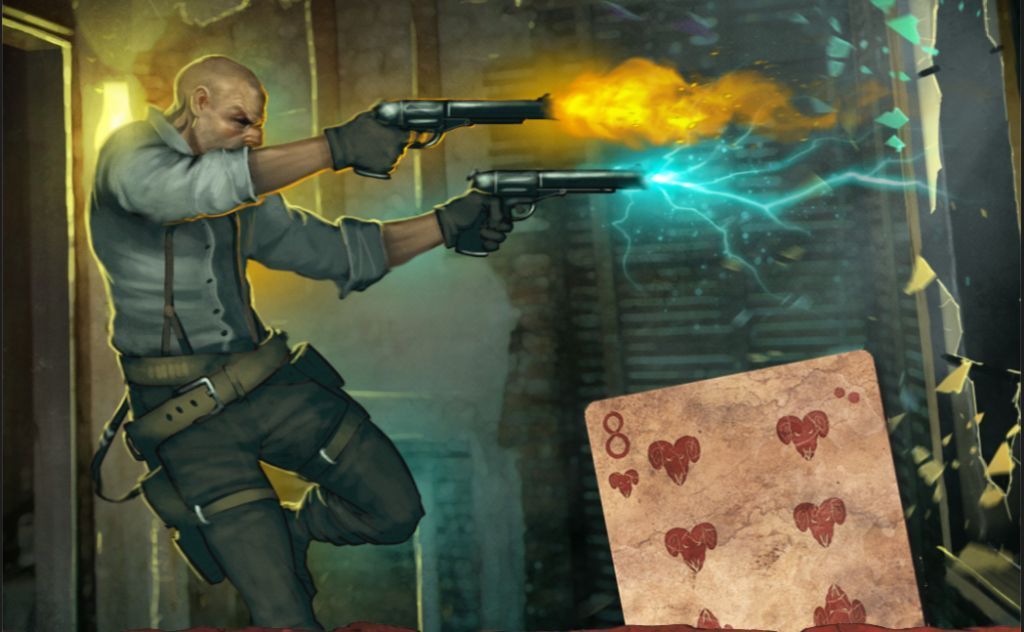
The proposition looks exactly like Deadlands's, the "Weird West Spaghetti", but Through the Breach pushes the cursor more openly towards Steampunk and horror. The other big difference lies in the preponderance of the city of Malifaux, where most of the PCs' adventures take place. To avoid confusion, let us specify right away that "Malifaux" is as much the name of a game as that of the city and of the parallel world in which the action takes place. Dirty, seedy, hopeless, its atmosphere is first carried by a coherent art direction, whose tones frequently flirt with the sickish, putrid yellowish or greenish.
The line
Role-playing games coupled with miniatures games are legion, as evidenced by Warhammer, Anima, Iron Kingdoms or Alkemy. In this context, the game is sometimes designed as a "derivative product" and risks, sooner or later, sinking into oblivion before having reached its full potential. Fortunately, Through the Breach already counts a considerable quantity of books, spread over two editions (a first one in 2015, the second in late 2017). The first iteration had given in to the siren song of the "player's guide and GM's guide" diptych, but the one that succeeds it has judiciously condensed all the content needed to play into a single 400-page book. The supplements are then divided into three categories: (1) the Expansion Books (200 pages and more) which broaden the context and rules presented in the core book, (2) the Penny Dreadfuls (around 100 pages) which offer a localized context along with a big adventure, and (3) the Penny Dreadful - One Shot (about 25 pages) designed as small standalone scenarios. As of this article, the count is four, eight and more than twenty publications in each category respectively. You will have more than enough to play Through the Breach with the content already released!
Background
The action takes place in the first years of the 20th century, after 200 years of alternate history. The point of divergence is the discovery of a portal leading to a parallel world organized around a deserted city: Malifaux, fittingly named. Both worlds live under the yoke of the "Guild", an authoritarian organization that "maintains order" while grabbing all the esoteric resources of Malifaux. Obviously, the Guild's power wanes as its competitors grow stronger, leading to open conflicts where rot and decadence lie in wait for everyone, without any exception. No good guys, just filth under the rug. Among the challengers, we count, willy-nilly:
- Malifaux's original residents, who seek to send humanity back where it came from;
- a group of unionized workers led by sorcerers who demand the right to openly use magic;
- a sprawling Asian mafia, blending triads and Yakuza (but mostly Yakuza), whose "yellow peril" overtones sometimes make one grind one's teeth;
- a loosely organized group of necromancers who want to destroy, or subjugate, all forms of life;
- a few non-aligned, generally depicted with more sympathy than the others.
This division into factions sometimes seems a bit artificial, a consequence of the adaptation of a miniatures game where each camp's perimeter must be established, even artificially, for balancing reasons. Then again, let us be honest: these very practical delimitations allow novices to easily grasp the universe, like the clans of Legends of the Five Rings. In this electric atmosphere, the players portray "Fated", humans set apart because they have seen, one way or another, a part of their destiny. They can thus count on "fate" to allow them to fulfill this divine ordinance, willy-nilly. These Fated travel to Malifaux for reasons defined by the group, although some of them may originate from this world. In fine, the strong themes of Through the Breach seem to revolve around its corrupt and corrosive atmosphere, which crushes any hope of a genuinely happy ending.
Mechanics
To my eyes, Through the Breach strongly stands out through its game system, singular in more than one respect. As an opener, a proof of good taste: like a growing number of modern games, it imposes no "tests" on the GM. Only the players resolve actions, even in physical confrontations. But rather than dice, card decks serve this purpose. The player whose character attempts an action flips a card from the top of the central pile, whose numerical value constitutes the base of a score to which the PC's characteristic and skill are added. Yet, the latter are globally quite low, so stingy is the **game in its point allocation at creation. Most characteristics oscillate between -1 and 1, skills rarely exceed 3. The character's particularities therefore only come marginally into play, at any rate until they become truly specialized through experience. Fortunately, the mechanics offer a rather original adjustment possibility: each character has a "Twist Deck" composed of 13 cards, a handful of which is kept in hand by their player at the start of the session. By "cheating fate", one of these cards can substitute for the one drawn from the top of the main deck after a test's result is revealed. Beyond the numerical result, the suit of the card used to resolve an action also allows triggering certain side effects mastered by the character. For example, at a certain degree of mastery, the Music skill can come with a "lullaby" trigger that puts its listeners to sleep, or another, "marching tune", that strengthens her allies.
"After you don the crimson silks, you will wait when you should act, for not all treasures glimmer in the light. The grave did not hold her, and he will watch you drink the venom." - Example of a destiny
Character creation aims to be just as original, but also dangerously random. Essentially, the player draws five cards whose suits and values determine the character's social origin and their points to allocate. All results are balanced; no question here of having a more powerful character than another. You will thus obtain scores to allocate like "3/-1/-1/-1", "2/0/-1/-1", sometimes "-2/-1/0/2". However, strangely enough, one draws a card for the physical characteristics (might, grace, speed, resilience) and another for the mental characteristics (intellect, charm, cunning, tenacity). These two categories will therefore almost mandatorily be balanced - impossible to have a character gifted in all mental domains but physically deficient. This will limit the most widespread clichés in role-playing games, for better and for worse. Beyond the very classic choice of a class (a "pursuit"), the character is enriched with two rather interesting aspects. First, a textual destiny is composed from the five cards drawn at the start of character creation. You will find an example in the quote above. Often sinister, sometimes very abstract ("the marble worlds become flesh again") or horribly concrete ("and you will die"), these destinies will not fail to tantalize the players as much as the GM, all the more so as they will very concretely compose the rhythm of your campaign (see below). Then, each character builds their "Twist Deck" by defining its content. One suit will be "dominant" and offer the strongest cards, the next will be "ascending", the third "central" and the last "descending" (the weakest cards). In broad strokes, these suits (renamed "ram", "raven", "mask" and "tome") define not only the character's personality and aspirations, but also their best chances of success and therefore, of using certain triggers - an indirect way of encouraging player and character to learn triggers tied to their personality.
Ultimately, Through the Breach explores a branch of "narrativism" that remains relatively untrodden. Some games seek to structure the intensity of the action during play, with mechanics like the Doom Pool meant to guarantee that luck keeps turning between GM and players, in the image of Modiphius's Conan or Coriolis. Others offer PCs with less "fixed" characteristics, leaving more room for the players' interpretation, as Wulin or Mythic Russia do so elegantly. Here, the system supports the structure of your scenarios and your campaign. Admittedly, it is not rare for a role-playing game to explain how a session should be composed, but Through the Breach blends its rules into it. As intended by the game, each session is composed of a prologue where no action may take place and during which the players can freely change their character's "pursuit". The comparison with a TV series episode is obvious: the prologue is the hook presenting the episode's theme, before the title sequence. And while the session's unfolding remains traditional, its end grants fixed benefits to each character: an automatic progression of one step within their "pursuit" and a single experience point. In addition, each session should put one Fated in the spotlight by playing one of the five parts that make up their destiny. At the end of the session, the character will receive a few additional benefits to compensate for (or accompany) their ordeal. The GM is expected to alternate the spotlights between the protagonists, until all of them have fulfilled their destiny, at which point the campaign should come to an end. From there, one can easily calculate how long a campaign will take you: 20 sessions for a group of four PCs, 25 for a group of five, and so on. The authors show common sense in specifying, however, that the fun can last if you wish the Fated to develop along axes other than their destiny (by following, for example, an "advanced pursuit" which corresponds to a prestige class, in D20 System jargon).
So, is Through the Breach any good?
Upon reading, certain aspects inspire slight fears in me. The biggest one concerns the very random side of character creation as well as actions, which can give the players the impression of controlling nothing. Nobody likes to invest themselves in a game where everything escapes us. What is more, if the Penny Dreadfuls I have read inspire me, their construction generally seems rather rigid and could make the most convinced "old school revival" players jump with anger. On the other hand - you will no doubt have felt it in my detailed description - I truly appreciated the system's originality, including its desire to structure the story rationally. And these destinies! Enough to rub one's hands for hours imagining a meaning for each Fated in the group. Beyond the game's intrinsic qualities, the already teeming quantity of additional content bodes a true richness in context and mechanical options. For some players, that is a flaw. For me, it would rather be an advantage - nothing prevents leaving the superfluous aside. Ultimately, beyond the role-playing game, it is also a pleasure to rediscover the universe of Malifaux and the strong personality of its art direction.
All the illustrations in this article are the property of Wyrd Games (including the cover illustration). I use them to illustrate my point.