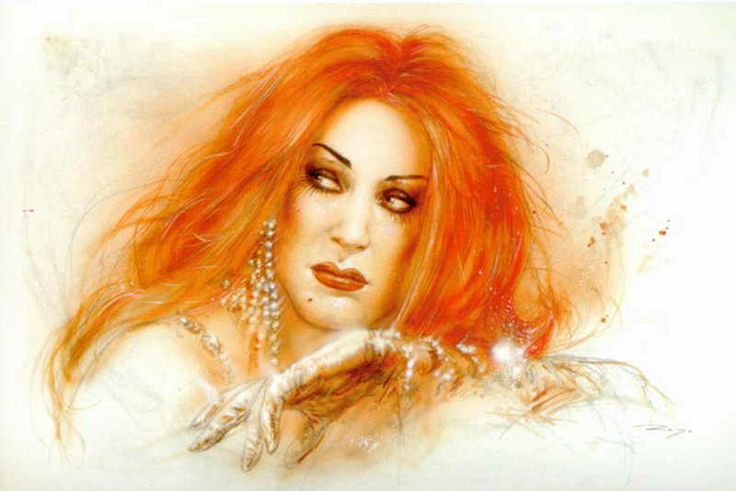
Plenilunio, Royo
sexism, and all that...
artistique · Article · mercredi, 7 septembre 2016 à 09:51:11 · 7 min
This post essentially focuses on the question "is Plenilunio a deeply sexist role-playing game?", to which I had already given the outline of an answer in a margin of my article about it. As it turns out, the debate has caused quite a stir within the RPG community (a good example here), and while we are at it, I would like to add my two cents.
- [First Look] Plenilunio
- Plenilunio, Royo, sexism, and all that...
All the illustrations in this article were created by Luis Royo. They are used here for critical purposes only.
The thing that strikes you after reading Plenilunio is the rather significant gap between the text and the images:
- The text claims to be feminist on account of the strong women it puts on stage, the ones who will lead humanity towards a new era.
- The images, on the other hand, fall into two broad groups: carefully wrought illustrations of women in lascivious poses, and quick sketches of male characters (or of old women). It is a bit as if the need to depict an entire universe - with its men and its common folk - had forced the Royos to hastily produce illustrations outside their comfort zone. The only exceptions to the rule are the illustrations of the (male) angels and demons, which restore a little balance with their more substantial care.
Let us try to address both aspects separately.
The text
The least controversial part of Plenilunio is its message, a self-declared champion of feminism. In a few words, here is what it is about: from its very birth, Humanity has always known the yoke of the "Solars", angels who act in the name of "Him" (God) by secretly structuring society and imposing a strict order upon it. To entrench their domination, the Solars manipulated public opinion through propaganda and established a harsh hierarchy in which every misstep is repressed in blood (among humans as well as within their own ranks). Ambitious and eager to rise among their own kind, these self-proclaimed agents of Good only avoid stabbing each other in the back for fear of suffering the same fate. This society composed exclusively of male models is now trying to prevent a change of era favorable to the "Fallen", the rebels who defied "Him" to shake up the established order. The latter are not particularly benevolent, but they at least spare themselves the hypocrisy and the fascist overtones. They are guided by "Her", the Moon and a feminine pantheon that has symbolically emancipated itself from "Him". The end of an oppressive male order at the unstoppable hand of a woman: that is why Plenilunio presents itself as feminist. And why not? It is still better than the myriad of games that take patriarchy for granted without denouncing it.
The fact remains that beyond the declaration of intent, there is still an awkward form of determinism in considering order and hierarchy as fundamentally masculine, while "savagery" and sensuality are perceived as feminine. This idea has crossed eras and cultures (the ancient thinkers of China and Greece thought alike): being optimistic, one can imagine that the authors insisted on this dichotomy by reference to those cultures, rather than out of personal inclination (as the authors of Wulin or Qin did). To add further evidence in the game's defense, one notices that while its universe leans towards determinism, its system does not in any way validate this point of view, making no difference between male and female characters. The same goes for the core book's scenario (I have not yet been able to decipher the one in the Spanish edition of the game's first supplement), which does not insist on the differences between men and women. Yet another strange paradox of this Plenilunio, the transgressive but consensual role-playing game.
The visuals
As often with Luis Royo, the collecting bug hit me. Shortly after "Plenilunio" fell into my hands, I quickly acquired the two Malefic Time albums, without however completely subscribing to the project. Is it a mere compulsive attraction to beautiful books? Actually, it is probably more complicated than that.
Can you feel the 90s? Source: www.luisroyo.fr
Luis Royo's work has been used so often to illustrate Metal albums or objects of the geek "subculture" that one ends up considering it slightly outdated, despite an undeniable plastic mastery. Reducing it to so little amounts to completely neglecting the visceral aspect that emanates from Luis Royo's works from the 2000s onwards, when the artist more or less dropped the adventurers, the big armors and the laser guns to devote himself to his almost frightening obsession with female models with perfect figures.
The man-woman relationship according to Royo? Nope, not just him.
In this, the work of Royo (the father, more than the son) is a perfect illustration of an ailment that affects the way we live: a veneration of the female body as an object of beauty and a rejection of the male body, which is either ignored or reduced to its most "basic" functions (to understand better, see the image above). It is enough to roam the world of online video games to realize the scale of the disaster, where female avatars constitute Grails so precious that many male players prefer to embody them, rather than stoop to playing a big heap of patched-together metal pieces (and I confess to contributing to this myself, by subscribing to this philosophy too, through my gaming habits or my few doodles). This problem goes beyond mere perverse voyeurism: we are not just talking about eye candy, but about a recurring impression that male characters have nothing to offer. In fact, one could even say that the only players embodying male characters are those who constantly put their sexual identity on the table ("I'm a dude... gotta play a dude, otherwise I'm a pansy...").
That said, the majority of video games still put male heroes on stage. I have the impression that female avatars are more successful than male avatars, but as soon as an avatar becomes a full-fledged character (endowed with personality and a history), we fall back into the idea that it can only be a man.
It is therefore hard to hold it against Royo, since he "merely" depicts, quite beautifully on canvas, the reflection of our unease. As a good artist, he even questioned this trend through a series of illustrations dedicated exclusively to male eroticism, which can be found in the first book of the Prohibited Book line (the list of Luis Royo's books). The fact remains that when leafing through the pages of Plenilunio or the Malefic Time albums, one can only sigh at the complacency with which the artist wallows in this manifestation of a sexism that harms men as much as women. Illustration after illustration, he ends up reinforcing this harmful trend that should rather be fought.
Playing Plenilunio without leaving the door open to sexism is possible. The game system and the scenario hardly encourage discrimination - no more than quite a few other RPG productions. The game universe can also be nuanced, not to mention the fact that your PCs - the true protagonists of your stories - will most likely include male individuals, defusing the man-woman dichotomy proposed by the authors.
Only the images remain problematic, so deeply do they take root in a genuinely sexist unease that gnaws at our whole society without being connected to the substance of the game. That takes nothing away from their technical mastery, nor from their evocative power: it is just that they are not in their place around a gaming table. Yes, GM, you will have to invest in a different screen...