
Article
A new step
powered by... Keiko
technique · Article · samedi, 7 novembre 2026 à 16:55:06 · 6 min
After more than five years on WordPress, then almost a decade living through Ghost, the Archives d'Anubis are migrating to a more modern base. This time, it is what is called a "static" site, meaning it needs no backend to exist. How good that feels!
For many long years now, Ghost's development has concentrated mainly on features for professional bloggers, like some self-hostable sort of Medium. I understand the appeal for a niche of specialists, but in my case, I have no pretension of demanding payments, building an audience and chasing public recognition.
Of course, seasoned web wanderers will chuckle upon discovering that "static site" is today synonymous with "modernity". Yet the process is not limited to editing raw HTML: you write files in Markdown format, you press a button, and it generates HTML files that are served "dead" on the Internet. Besides the clearly superior performance, one also limits the attack vectors - that has become very important lately [1]...
Why stay online permanently, if it is to edit content once a year?
CMSs like Hugo already delivered on this static-site promise more than ten years ago, but I found it rather difficult to develop the modules needed for the sometimes quite specific implementations that were requested of me. Hence Keiko, my personal site generator. I developed this technical base as part of my work for the Atelier Vandy. Our first clients, for whom we had chosen Wordpress, often struggled to keep their sites up to date, so much so that in a short time, they turned into vulnerabilities exploitable by ill-intentioned individuals. Hard to keep offering such services, especially now that the nitwits at the head of the American companies selling aytch-eye [2] seem not to care about basic cybersecurity rules, like warning the maintainers of a technology before disclosing a vulnerability, and leaving them time to fix it. Dear readers - do your best to reduce your attack surfaces as much as possible...
1: The Keiko Backoffice interface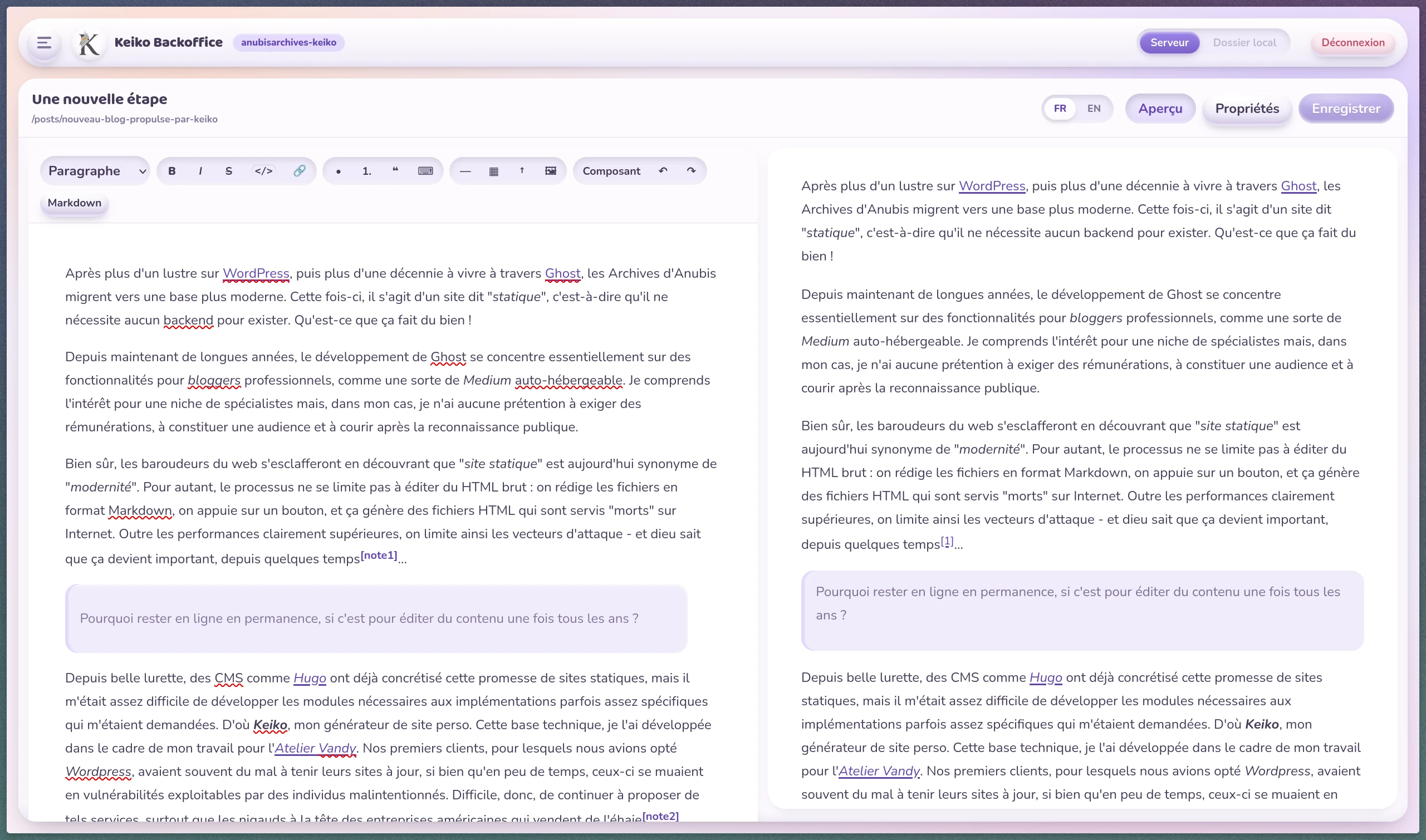
As for the name, Keiko, it is a reference to my "clingy" bird, who, once out of the nest, had hidden in the wood shavings that made up her litter in the hope that we would not notice her. Just like her, it is by survival instinct that my static site generator - the backoffice part - hides as much as possible so as not to offer a flank to attack. Why stay online permanently, if it is to edit content once a year?
I must admit that aytch-eye was not completely foreign to this migration. Whatever the aytch-eye-atollahs may say, for whom my adoption of this technology is not blind and religious enough, I do not intend to remain ignorant and spit on a novelty on principle. For the conversion of data from SQL to structured Markdown, first of all, it was easy to say "You see these XXX and ZZZ properties? Convert them to AAA, then remove the YYY properties whose values resemble BBB, while you are at it". A deterministic script could have handled the work just as well, but often, in such a situation, the time required to create said script (and to account for the many "edge cases") exceeds the duration of the manual work. There, I grant, my local agent spared me at least 45 minutes of "monkey work" at each step of the migration.
For prototyping, next, aytch-eye helped me when the time came to imagine the new version of the Archives d'Anubis. In the past, I would have scoured the web in search of inspiration. Here, I was able to start with functional prototypes generated from my prompt, looking for graphic ideas that would fit my needs. The real danger of such an approach is that the space of possibilities shrinks drastically [3]. Indeed, the prototypes generated by modern LLMs have the nasty habit of all looking alike - as much as generated images [4], in the end, but nothing prevents drawing a few ideas to graft them onto a more coherent design. On the other hand, when it comes to "boilerplating" a project, I admit that modern models made my life much easier, even if the goal remains to create a true deterministic boilerplate rather than delegating the "annoying" setup (eslint, containers, etc) to a probabilistic text generator.
Finally, I delegated to Kimi K2.6 the code reviews that would ideally have been entrusted to colleagues, for the simple reason that my work here is purely solitary. Among the suggestions, a small third seemed relevant to me. That much taken. It is perhaps there that these tools show their greatest usefulness: they make it possible to partially compensate for a lack within a team, by providing a result that oscillates between mediocre and acceptable, in UX as in software engineering. As long as we are talking about advisory use, the suggestions remain worth taking.
If one can consider these tools useful in very specific contexts, I however find it hard to skip over the whole set of questions related to ethics - I include here ecology as much as the attribution of the sources used to train the models - as well as the problems of cognitive disengagement, or the risks of abusive use on the development of the fields where these language models try to substitute themselves for humans.
To get back to the Archives d'Anubis Keiko-style, I will try to return to a more regular writing rhythm. The new timeline does not lie: it shows how much my previous job siphoned my motivation to maintain my side projects (and not just those...). My new professional pace leaves me a bit more energy outside of working hours, and since I have a number of topics to address, the blog will probably fill up with "posts" more frequently - of a still essentially playful nature, even if technological questions will resurface on this blog after 9 years of absence [5]. As for artistic topics, once I have found a way to limit the risks of crawlers coming to sniff my drawings to use them as a training base, I will take the opportunity to show you what my wife's good lessons could inspire me. See you soon!
A thought for my former colleagues who must patch sites running old PHP following... The Vulnerability. ↩︎
Yes, yes... "Artificial Intelligence", I know... and their masters are the aytch-eye-atollahs. ↩︎
Zamfirescu-Pereira, J. D., Jun, E., Terry, M., Yang, Q., & Hartmann, B. (2025). Beyond Code Generation: LLM-supported Exploration of the Program Design Space. Proceedings of the 2025 CHI Conference on Human Factors in Computing Systems. https://doi.org/10.1145/3706598.3714154 ↩︎
The idea behind the verb "Yassify" - this trend of smoothing faces so they all resemble "beauty" canons... ↩︎
Last post on the topic: August 10, 2017. It does not make us any younger! ↩︎