Wulin (V2)
"For a Few Chrysanthemums"
ludique · Article · mercredi, 19 décembre 2018 à 19:34:55 · 12 min
While I wait for the motivation to wrap up my post-mortem of the Cinq Supplices campaign for Call of Cthulhu, let me offer you a report on our first one-shot of "Wulin: Purple Lotus Edition", which will probably be followed by another for our second one-shot, currently in play (you know my editorial reliability). As our scenario, we played "For a Few Chrysanthemums", the dense plot offered in the core book of the first edition. An opportunity to apply myself to correcting the flaws of my 2015 GMing!
- Wulin (v1), "For a Few Chrysanthemums"
- Wulin (v2), "For a Few Chrysanthemums"
- Wulin (V2), "Backdraft"
Wulin: Purple Lotus Edition
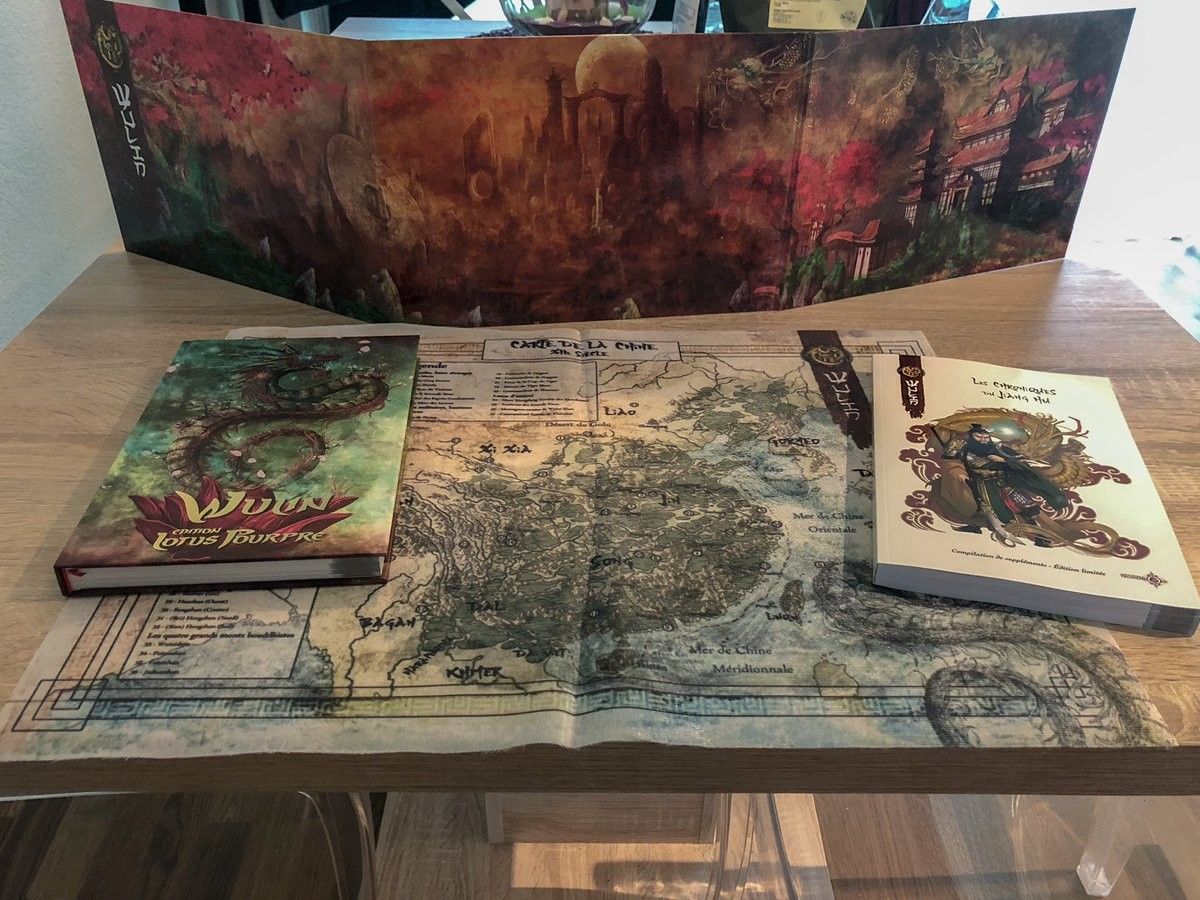
Wulin: Purple Lotus Edition is the second iteration of a tabletop RPG devoted to capturing the atmosphere of Chinese cape-and-sword stories. The first version, Wulin: Chronicles of Brush and Sword, inevitably struck me right in the heart, fondly recalling the golden years of our Qin: The Warring States campaign. This overhaul was justified for several reasons: beyond costly problems with the first edition (see, among others, the publisher's interview by Le Fix, part 1 and part 2), the quality of the book could be improved, the rules suffered from a lack of synthesis and could also benefit from small adjustments. A crowdfunding campaign to the tune of €35,000 allowed this project to become reality; I hope it meets the success it deserves.
In terms of atmosphere, if you already know Qin: The Warring States, consider Qin and Wulin to form a diptych. Qin depicted the birth of an imperial, unified and modern Chinese culture, one that shoved wandering heroes, misfits and their world of superstitions into the closet. In Wulin, we find that rigid, hierarchical society out of breath, some 13 centuries later. Sclerotic, it collapses in on itself, malfunctions to the point where its population suffers. Improbable heroes, in the image of those of old, then reclaim their place and their legitimacy among the oppressed, like a glimmer of hope amid political stagnation and economic insecurity.
Let's quickly sum up the basics of the game: players are invited to create Youxia, popular, superheroic righters of wrongs, who stand against the decay and the enemies of the Southern Song, a 12th-century Chinese dynasty. These characters are defined as much by factual data (as in most tabletop RPGs) as by the rumors and hearsay circulating about them. Reputation is at the heart of the system, pushing your players to perform their characters with flair and grandiloquence. One can point out a few residual clunkers, a few potential imbalances, but none of that matters in the face of its originality and coherence. The risk-taking incentive mechanics command respect. Not only do they fit the setting and the soul of the game (among other things, you use D8s, the score "4" is harmful, the score "8" ultra-positive), but they naturally change player behavior. An example: in a traditional game, you roll your dice and hope for the best possible result. Chance will tell to what extent the daring player trying to get their PC across a ditch will succeed. In Wulin, as in Legends of the Five Rings, you wager. First, you negotiate with the GM to determine which rumors come into play for your action. Sometimes the action will even be so beautiful that your companions around the table will sacrifice a few legend points from their characters to grant you additional chances. Then, you set the difficulty threshold to reach yourself. Finally, you roll the dice. If the result is below your predictions, the system offers a few options to make up for it (taking on "Yin" or "Yang" points which, over time, can drive you mad or sick). But the beauty, the finesse of the system lies in the fact that it punishes excessive caution: if your score ever exceeds the threshold you set for yourself, your character suffers a loss of breath points equal to the difference between the wagered threshold and the score obtained. They poured too much energy into an action that asked for no such thing. The timid will quickly learn, over the course of a fight, that it is better to miss an ambitious attack than to run out of breath limiting yourself to inconsequential jabs. I no longer remember exactly which of Laurent Rambour - the publisher - or Nicolas Henry - the author - is a big fan of the "Wushu" system, but the kinship is palpable: with Wulin, play boldly, or take the risk of taking the knocks. And yet the student far surpasses the master, as Wulin seems to me far more coherent, structured and consistent than Wushu.
I will come back to the game and its system at greater length, either in the report on our second one-shot, or in a fully-fledged article. Be that as it may, know that this fine Wulin drew unanimous enthusiasm from our players (9 people), to the point that one of them has in fact invested in the line in order to GM it in turn.
Our one-shot: For a Few Chrysanthemums
Woe to you who would read the section below if you ever wish to play this scenario from the PCs' side: my article reveals critical parts of this script and you risk spoiling your own fun.
The canal in the city of Wuxi, contemporary period. Copyright Hana169, under CC-BY-SA license. Source: Wikipedia.
"For a Few Chrysanthemums", the scenario we played, thus comes from the first edition. It takes the form of a tournament that an event will turn into an investigation. Two individuals threaten the life of Kang Aiwei, the governor of the city of Wuxi. One acts out of pure pride - Liu Taizhong, a power-hungry right-hand man - and the other out of vengeance - Yue Zhu, a Youxia whom Taizhong manipulates by making her believe that her former lover Aiwei abandoned her. My first 2015 team consisted of mercenaries, naturally inclined toward vagrancy, alcohol and tomfoolery. Unsurprisingly, they explored the city through its underbelly, neutralizing the two antagonists without ever understanding their motivations (you can find the endless recap of our adventures here). This time, I was determined to rectify my many approximations (notably the locations, the times, the buildings) and to give the players the final word of the story. The 2018 team created a group "in the style of the Yang clan", a family of sword nobility, marginalized by the literati and bellicose toward the Jin invaders. Naturally, with contacts in the government and the army, the group mostly explored the higher spheres. But one of the family's daughters had an artistic streak, so she gladly fraternized with the rabble and the actors - a golden opportunity to bring on stage the various NPCs likely to recount Yue Zhu's story. The other daughter of the family, prickly, was close to her shifu: so I took the opportunity to suggest that she could be An Liang's disciple. With my "pieces" in place, everything suggested the plot would untangle itself. Fortunately, I had wagered nothing on that. While the team quickly obtained proof of An Liang's involvement in the plot, preventing her from assassinating Tong Lipo and getting the deadly poison, they did not follow up on other leads. Late in the game, they discovered the secret of the Peony Demon, but let the demon assassinate Abandonment Revealed without digging any further, offering Liu Taizhong an opportunity to wipe out that whole little world in one stroke. The upshot is that An Liang was indeed subdued during her direct assassination attempt on Kang Aiwei (a few phenomenal, quasi-cosmic dice rolls were needed on that occasion), but she did not breathe a word about her reasons. Taizhong thus came out unscathed, even though he could not pull off his plan. A muted victory, even more frustrating than the first group's. Now, granted, this second group sinned through caution, no doubt too used to Call of Cthulhu and to the risks that unreasonable displays of initiative imply. Compared with the merry pranksters of 2015, who amused themselves setting fire to the city's warehouses, it is night and day.
Beyond this particularity, the scenario itself invites you to miss leads. In 2015, I made a mistake underestimating the preparation required to run it properly. And for good reason, calling this "rich" is a euphemism: over the handful of days this adventure spans, the PCs can (1) meet a good thirty NPCs (and more still, with the new detailed description of the city), (2) take part in a tournament (as a reminder, that simple fact constituted a scenario in itself in Legends of the Five Rings), (3) solve an investigation via three leads whose ramifications are sometimes tenuous, and then (4) possibly take part in a siege whose gravity will depend entirely on their actions. GM, you will also need to know the city of Wuxi to perfection to convey the full originality of its setting and offer your table material to hold on to. Ideally, finding a few modern photos to represent Chang'An Avenue or Turtle Island would not go amiss. In short, you will inevitably prepare a great many details your players will attach no importance to: they will certainly bite on one or two leads and untangle them with care, but an overall understanding of the story will almost inevitably slip right under their noses. Hence my frustration. Here are a few more practical remarks and tips to help you exploit the full potential of For a Few Chrysanthemums:
- Absolutely look for images to illustrate the NPCs. Our 2018 team had small illustrated cards for (almost) every character encountered. These game aids will let the players calmly think through the connections between the scenario's NPCs and - who knows? - avoid forgetting any of them. I picked my images from the officer portraits of the "Romance of the Three Kingdoms" video game series. Lacking images, at the very least print small cards your team can fill in.
- Likewise, the map of Wuxi is a game aid to print at all costs.
- The conviction of the PCs failed in both my runs. The evidence against them was far too thin to justify a genuine disgrace (especially the second group, respectful of the law, which refused to infiltrate the Yamen in pursuit of the Demon). What's more, it only takes one loquacious character on your team to turn the wind in their favor during their plea. Then again, maybe I do not play my NPCs meanly enough.
- Liu Taizhong, as a proper "evil right-hand man", immediately drew the suspicion of both my groups. Even if your team refuses to trust scenario clichés, they should still uncover one of his plots without difficulty. So there is no point in spelling out too many leads about him.
- Saving Kang Aiwei from the poison seems just as obvious. Protecting him from An Liang's wrath, on the other hand, is immediately dicier. In 2015, I neglected the rules a bit to let the PCs gain the upper hand quickly. In 2018, the players most judiciously used their points to put the Youxia out of action (luck played a big part too, for one dice roll away, Kang Aiwei would have kicked the bucket). Keep in mind that with such a powerful character, it would be easy to kill the governor off without the PCs being able to react.
- In both my runs, the lead of Guo Jie, the drunk scribe, passed right under the players' noses. Without Guo Jie, it is hard to find all the pieces of the puzzle and understand the truth about An Liang. It is therefore critical to put this NPC in front of your players. In my second run, I reintroduced Guo Jie to the court through Liu Taizhong. These details were supposed to pique the players' curiosity, in vain.
- Even if your team managed to understand the reasons for Guo Jie's guilt, it would not necessarily be easy to grasp that the governor still harbors noble feelings for Yue Zhu, whom he believes dead. The best possibility raised in the scenario is to involve the governor's wife, but it is not easy for the average Youxia to approach such a person. In my 2015 run, I had decided that Aiwei went to a temple every evening to say a prayer - an opportunity to approach him and his wife, but also to understand that he was mourning a loved one. That seems to me a necessary detail to make him accessible to the PCs. In our case, they had formed a vague idea of the situation, but nothing that could connect An Liang to Kang Aiwei (since Guo Jie was blowing bubbles with his blood in his residence).
There you go, with all these details and precautions in mind, I think you should be able to enjoy the best of this scenario. Despite its complexity, it offers highly rewarding freedom of action within a rich setting. The many game aids, the abundance of memorable NPCs and the city itself suggest enough elements that, even when short of ideas, you can answer the players' actions with consistency and without hesitation.