Post-Mortem
Cinq Supplices
Book 3
ludique · Post-Mortem · mercredi, 18 juillet 2018 à 06:47:56 · 6 min
We have seen how our team handled the scenarios of the second book of the Cinq Supplices campaign for Call of Cthulhu. Let us now move on to the next one, the third volume.
If you stumbled upon this article by chance and plan to one day play the campaign from the PCs' side, I invite you to read no further.
The second book of scenarios covers only one adventure, leading the group of investigators from Paris to Dairen by air. As indicated in our statistics, this is the biggest discrepancy in time between the author's forecasts and how it played out within our group: we are talking about half the expected play time.
Forum summaries:
In short
Wordle of session 4, "From Paris to Baghdad"
Wordle of session 5, "From Baghdad to Hanoi"
Wordle of session 6, "From Hanoi to Shanghai"
Wordle of session 7, "From Shanghai to Dairen"
After Sayk Fong Lee's departure from Paris, the group meets up with Mei Fang, packs their things and joins Georges Guédon to take off for Rome. There, the Vatican provides the first leads towards the Christian monks of the East, the very ones Louis Lonsdale talks about in his precious journal. The trip proves uneventful until they leave Latakia, where the investigators get the opportunity to intercept and covertly neutralize a crew working for Sayk Fong Lee. They finally reach Baghdad, where their investigation leads them to Tarec, who provides them, among other things, with the formula that will, much later, eliminate the pillar of darkness that will threaten Manchuria, and the whole world. In Djask, they make sure that Sayk Fong Lee's last henchman cannot leave the prison, then finally reach Hanoi. The confrontation with the Dacoits - the campaign's second real fight - leaves two characters gravely wounded. The political intervention of Georges Guédon's friends nevertheless allows the group to resume its route, with a detour to Fort Bayard to find the famous folding screen their enemies were after. Our protagonists make sure its restoration continues, then push on to Macao and Shanghai. There, they come into contact with the treacherous Mr. Piang, who "recommends" them to the Dairen antique dealer Kang - both being allies of Sayk Fong Lee. They also search Lonsdale's deserted house, in vain, but learn that a rather imposing ship was recently seen at its dock.
When the plane takes off again, it is straight for Dairen, without stopping at Port Arthur. Once on Japanese territory, the investigators undergo a rough interrogation by the authorities, then are invited to lodge at the Yamato Hotel.
Commentary
Given our play time, I would say this part of the campaign perhaps lacks contextual information, or even a few suggestions for side plots, so as to give body to each destination. In fact, I wisely exhausted the book's content. Despite that, some stopovers (Athens, Djask, Macao, ...) were limited to the description of the airfield, the welcome committee and the place where the crew spent the night. Then again, it is hard to blame the scenario's construction: it would hardly be realistic for every stop of a journey of more than a dozen stopovers to hold a secret useful to the campaign. As the GM, know however that these stopovers will constitute one of the rare moments of the campaign where the PCs and their players can indulge in personal research and develop their personality. From the arrival in Dairen onwards, the pressure exerted by the political climate will leave the group little time to loiter.
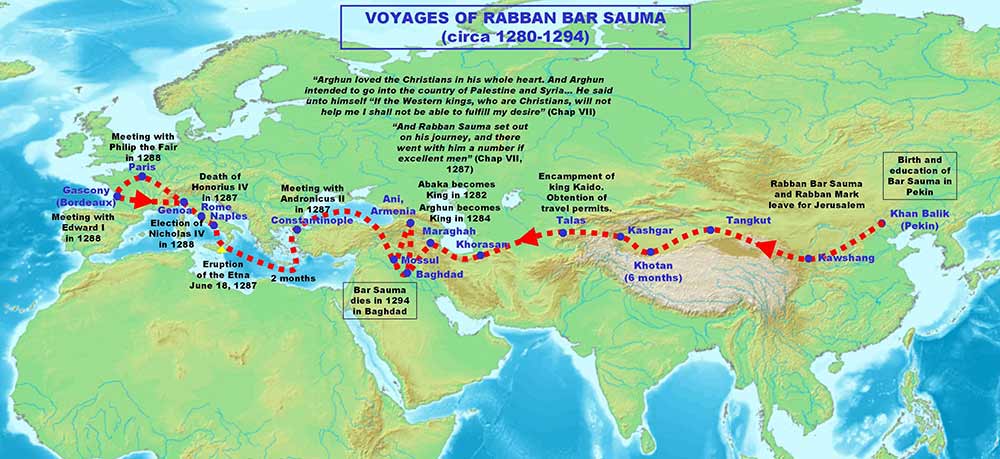
Among the points that pleased me, this chapter of the campaign unveils little-known parts of Christian history. Let us note, for example, the surprised comment of a player realizing that the occult adventures of Rabban Cauma and Rabban Marcos blend into historical reality. Other positive aspects? The plane trip is a typically pulp element, plunging the group directly into a state of mind in line with the campaign. Beyond the "tourism and exoticism" atmosphere, this sort of "buffer scenario" makes an effective link between familiar Paris and hostile Dairen. The interrogation by the Japanese customs acts like a slap that wakes the players up, telling them "the fun is over". In the end, I see only two challenges posed by this chapter:
- Kang and Piang are rotten, but the campaign will only reveal it with difficulty. In fact, the presence of the Japanese in Dairen and in Bayuquan means that Kang can appear as a mere coward, rather than an enemy proper. As for Piang, my players had simply forgotten that he was the one who recommended the antique dealer to them. Is this a real problem for the campaign? Not really. Just a manipulation that will most likely go unnoticed in most groups. Elements invisible to players are often useless.
- More problematic, your group may miss the trail of the folding screen, so tenuous is it, all the more so if the PCs missed the visit to the Paris world's fair (itself rather under-highlighted by the plot). If your players are unaware of these clues, you will either have to force their hand (BOO! RAILROADING GM!), or accept that they never find the folding screen - and therefore, that the supreme tattoo leads nowhere at the end of the campaign. The author warns that it is important for the folding screen to be restored: in truth, our group could have done without it (we will come back to this in the commentary of the last part of the campaign). So see no obligation in the rescue of the folding screen. It is one of the very many cases where the author's writing style can make one believe that an outcome is mandatory for the campaign to hold together, when in fact the scenario gives you enough keys to easily adapt it to the players' actions. Since this is a recurring problem, I will rather deal with it in the conclusion of my Post-Mortem.
An opinion to share about this article? You can leave it on the dedicated topic of the Organisation Très Secrète forum.