Qin - Tianxia
the Retrospective
ludique · Article · lundi, 23 novembre 2015 à 15:23:57 · 15 min
Now that everything works more or less correctly on the technical side, it is time to feed this blog with articles. If my Piwik statistics are to be believed, RPG enthusiasts are always fond of session reports, post-mortems and other session recaps: how convenient, I like writing them.
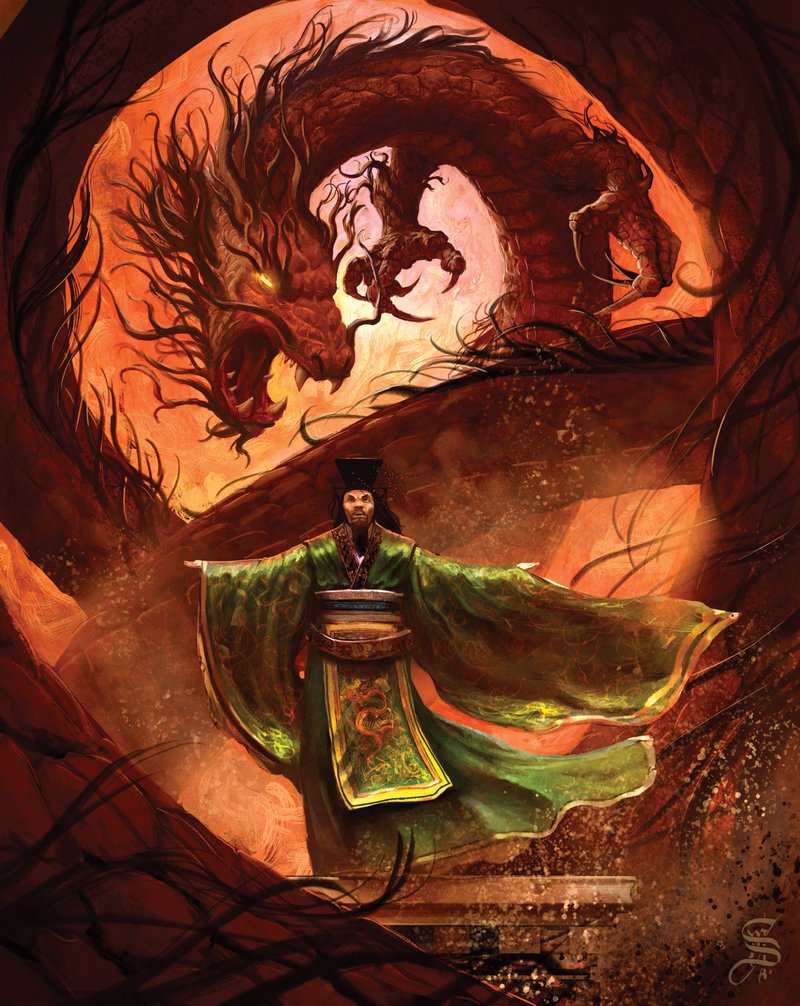
Disclaimer: The cover illustration of this article comes from the "Qin: The Warring States" line, belonging to Éditions 7ème Cercle. The character portraits come from "Romance of the Three Kingdoms 10", by Koei Ltd.
While waiting for the publication of the Post-Mortem of our Wulin one-shot[1], it is time to pay tribute to our venerable "Qin: The Warring States" campaign, run between 2006 and 2010. Two reasons for this:
- I have written quite a bit about Cthulhu, a little about Anima and Pavillon Noir. However, never about Qin, even though it is my best RPG memory.
- Even if it depresses many of us, we celebrate 10 years of Qin this year[2]. Next year, it will be our campaign's turn.
So I am going to dust off, as much as possible, the recaps of the good sixty sessions needed to conclude our campaign. My goal is to rewrite everything with a uniform tone and to offer a smoother read.
As usual: if you plan to play this campaign from the "PC" side of the table, reading all the recaps to follow is strongly discouraged.
Context
"Qin - Tianxia" is a campaign published by le 7ème Cercle for the "Qin: The Warring States" line between 2006 and 2007. The adventure splits into two books and thirteen scenarios, fleshed out by a more or less official "prelude" in the booklet that comes with the screen. With authors like Jérôme "Brand" Larré and Romain "Rom1" d'Huissier at the helm, this campaign aimed to break certain taboos in traditional tabletop RPGs, even if it meant embracing a stance hard to swallow for a sizable number of players. On the menu of festivities: a will to emotionally involve players through their characters, deadly rivalries between PCs, self-programmed bitter defeats, a certain linearity in the presentation of scenes, and so many other peculiarities that are as many flaws for many roleplayers. In my eyes, and as you will discover over the course of the session recaps, le 7ème Cercle's bet proved worthwhile.
We are talking here about a semi-historical campaign, based on the rise of the Qin dynasty — and more specifically of "Qin Shi Huangdi", the first Emperor of China known to one and all for his mausoleum[3]. To avoid relegating the PCs to spectator status, every shadowy corner of History has been exploited to make them the major actors of this era. While it quickly becomes clear that Qin will ultimately prevail — erasing as it does any possible contradiction between the characters' beliefs and the players' historical knowledge — the manner and the meaning of this victory keep fluctuating over the course of the plot.
A long-haul campaign, in game hours as well as in narrative years (twenty years pass between the beginning and the end of the adventure), "Qin - Tianxia" lets players develop their characters and flesh out their backstory little by little: whether they start as a mere blank page or a walking cliché, the PCs naturally take on nuances when confronted with the dilemmas and powerful situations offered by the scenarios.
The Butchers of Quzhi
Following an event related in the "Treacherous Prince" scenario[4], the PCs earn the sinister nickname of "Butchers of Quzhi". Below you will find the description of our Butchers of Quzhi. In bold, the names of the PCs who finished the campaign.
Initial Group
(-240 BC)
Chen Chi, "Soothing Hand" (sessions 1-4): a wandering physician adept of the staff, amnesiac, whose only memory is a jade tiger. I had intended to make him the brother of a Qin officer — descended from a line of ranking soldiers. The character left the campaign at the same time as his player, only to make a fleeting return during Tian Zaisheng's rescue.
Cheng Minh, "The Snake" (sessions 2-55): an assassin of the Five Venoms Sect, Minh was initially set on the trail of Red Beak from the very first scenario. Standing out as an opportunist anti-hero but not heartless, "The Snake" became the sworn brother of Liu Mei Shan and frequently opposed the sanctimonious Zaisheng. He also served as comic ballast in many a situation. In the second part of the campaign, Minh temporarily became the leader of a band of brigands — the Consortium — before being deposed from his post. He took revenge on his uncle — Master Lizard, one of the heads of the Five Venoms Sect — and obtained the post of Minister of the Censorate of Dai.
Ciu Wang (sessions 3-4, 40): a wandering scribe from a good family, Ciu Wang accompanied the future "Butchers of Quzhi" during their meeting with Lo May, the venomous cat-woman. He made a short reappearance as a PC shortly before "The Celestial Flame" and then served as an NPC within the court of Dai.
Cui Yuan Foc Sui To, "Thirsty Panda" (sessions 2-4, 18-36): a tall, broad and alcoholic exorcist, "Thirsty Panda" stood out for a while as the expert on celestial phenomena, until he disappeared for many a year. He crossed the Butchers of Quzhi's path again a good five years later and rejoined the team until his exile from Qin. Easygoing, he discovered the secrets of Wine during a surprising encounter with a Roman scribe who had strayed into Chinese territory. Thirsty Panda remained within Dai's government as an NPC until the end of the campaign.
Liu Mei Shan, "Ten Thousand Springs" (sessions 1-67): a spy of the Black Carapace, having joined its ranks in the wake of a family tragedy. She posed as a merchant before revealing her true identity to her "Butcher" companions. Playful by nature, Mei Shan carried on romances — sometimes one-sided — with many individuals, until she became a mother by accident. When her son was taken from her in a murky political affair, she devoted most of her efforts to finding him. Having become Minister of the Censorate and of Counter-Espionage within Dai, Mei Shan pursued the group's goals fervently until the last minute. She became Immortal, obtained the secret title of "Sacred One of the Cat" shortly before Qin's unification of the Zhongguo, before renouncing it to join the imperial administration. She is also the one who hurled the First Emperor from the top of a cliff. In doing so, she indirectly ushered in the start of the post-Qin era, from which her cousin, Liu Bang, would emerge victorious.
Liu Mei Shan. Copyright © Koei Ltd
Lu Yan Sheng (sessions 1-4): a soldier of Zhao, a thick brute forged in the image of his probable descendant Lu Bu, Yan Sheng was assigned to the guard of Nao during the events of the first scenario. He left the group shortly before "The Treacherous Prince" began, like Soothing Hand, Ciu Wang and Thirsty Panda. Yan Sheng returned in the form of an antagonist NPC during the "The Trap" scenario: loyal to his kingdom, he rose through the ranks to become a general of Zhao. It is therefore no surprise that he resisted Qin and ended up captured by his former traveling companions.
Tian Zaisheng (sessions 1-67): a prince of Qi, disgusted by the shenanigans of the political world, Zaisheng became a Mohist. Endowed with a pragmatic vision of his master's teachings, he regarded the unification of the Zhongguo as the guarantee of the universal peace Mo Zi advocated. That is how he accepted to serve the notorious kingdom of Qin in its conquest of the Zhongguo, even if it meant turning a blind eye to manifest injustices. Stoic, unshakeable, paternalistic, moralizing and expedient: these are the epithets that best stick to the fallen prince. Zaisheng frequently opposed Sun Keng Wai's overflowing opportunism and Cheng Minh's nonchalant greed. During his wanderings, the Mohist rose to the ranks of captain of the "Butchers of Quzhi" and Minister of War of Dai, foiled a plot hatched by his mentor in Qi, was assassinated following an act of treachery within Dai, and returned from the Underworld as an Immortal. He accepted to support Qin after the unification, to make sure his wishes of universal love became reality.
Tian Zaisheng. Copyright © Koei Ltd
From "The Treacherous Prince"
(-239 BC)
Sun Keng Wai (sessions 6-67): a soldier hailing from Wu, having trained in Zhao, Keng Wai first stood out as a peerless archer, a hopeless seducer and a hot-blooded careerist. A possible descendant of Sun Zi, he contemplated his ancestor's glorious past with envy and disdain. His enthronement within the Censorate of Qin finally gave him the chance to shine — if only the shadow of the ever-so-serious Zaisheng and his accursed glory-magnet hadn't hung over him. During the five years that followed his exile from Qin, Keng Wai enlisted in Chu and married Meixia, his beloved of tragic fate. He was struck down by Dark Mass at the top of Dai's palace before being reincarnated in the skin of King Ying Jia. The weight of responsibilities was nothing compared to the terrible revelations about his origins, and quickly, Keng-Wai-turned-King turned to philosophy to find meaning in his existence. Once himself again following Nu Wa's restorative intervention, Keng Wai completed the unification of the Zhongguo alongside his brothers in arms. Without hesitation, he accepted to serve Qin, on condition of being allowed to govern his native province of Wu. In fine, he took part in the assassination of the First Emperor and offered Liu Bang the Celestial Mandate with a view to a fruitful long-term partnership.
Sun Keng Wai. Copyright Koei Ltd
Wu Lin, "Snowflake" (sessions 6-17): a young Taoist apprentice versed in internal and external alchemy, "Snowflake" was one of the original "Butchers of Quzhi", since she took a direct part in Prince Cheng Jiao's overthrow during the siege of Quzhi. Constrained and forced, she accepted to join the Censorate of Qin and was traumatized after devoting herself to executing the King's bastard half-brothers. She then left her traveling companions at the first opportunity, during a mission outside the lands of Qin.
From "The Celestial Flame"
(-225 BC)
Du Ah Huat (sessions 41-67): a powerfully built man who lost his family in the wake of Dai's tumultuous capture, Ah Huat was a respected Shifu from the small village of Noi. His impressive reputation earned him a place within the government, where he became the "voice of the people". Fiercely opposed to every decision that could bring suffering to the common folk, he repeatedly threatened the King and his advisors with mutiny should they ever take decisions contrary to the common good. Ah Huat found Zibu, his former rival, during a Martial Arts tournament held in Chu. The man blamed him for the death of their shared love — Ah Huat's late wife — and swore to make him pay for this weakness. Just like Mei Shan and Zaisheng, Ah Huat became an Immortal when he returned from Feng Du, the Chinese underworld. He was able to put an end to the conflict with Zibu shortly before the unification of the Zhongguo and also accepted a position within Qin's government. That said, and contrary to his comrades, he did so only to exploit his closeness with the First Emperor in order to assassinate him. Unable to carry out his task, he joined the Celestial Mountains to await another opportunity. If Mei Shan pushed Qin Shi Huangdi off the top of a cliff, it was Ah Huat who first hurled him over with a violent lance strike.
Du Ah Huat. Copyright Koei Ltd.
Feng Tsui Dong, "Wind That Strikes Thrice" (sessions 43-67): a tattooed street performer with a murky past, fascinated by the wealth and plurality of the Zhongguo's cultures, Tsui Dong was the perfect opposite of the rest of the group. More favorable to Red Beak and to the Sect of the Tilted Sky than to Qin, the young man joined the Butchers of Quzhi during Chu's annual Martial Arts tournament, in which he distinguished himself through his unusual mastery of the Flying Guillotine. He offered his companions new, less Manichean perspectives and became the mentor of the young Xiang Yu. His openness to the Sect's ideas made him a willing sympathizer and a forced spy, until he freed himself from the Sect Master's influence shortly before the unification of the Zhongguo. Against all expectations, he also accepted to work for Qin — for he saw in it the only opportunity to resist the cultural homogenization policies promulgated by Li Si. Noting his powerlessness, he left the government, reluctantly accepted to support Xiang Yu in his preparations for revolt against Qin, and symbolically took revenge on Li Si by taking him hostage during the assassination of the First Emperor, before leaving him adrift on the Yellow Sea.
Feng Tsui Dong. Copyright Koei Ltd
Session Recaps
Campaign Preamble
- (June 3, 2006) Session 1: Toward a World of Lakes and Forests (1)
- (December 16, 2006) Session 2: Toward a World of Lakes and Forests (2)
- (February 27, 2007) Session 3: On the Road to Yanshan - An Eternal Lover
- (March 17, 2007) Session 4: An Eternal Lover
- (May 19, 2007) Session 5: The Prisoner of the Desert
- (June 16, 2007) Session 6: The Prisoner of the Desert (2)
- (July 14, 2007) Session 7: The Treacherous Prince
- (August 4, 2007) Session 8: The Treacherous Prince (2)
White Tiger of the West
- (August 25, 2007) Session 9: Revolution at the Palace
- (September 22, 2007) Session 10: Revolution at the Palace (2)
- (October 21, 2007) Session 11: Revolution at the Palace (3)
- (November 3, 2007) Session 12: In the Service of the Censorate
- (November 17, 2007) Session 13: In the Service of the Censorate (2)
- (December 1, 2007) Session 14: In the Service of the Censorate (3)
- (December 29, 2007) Session 15: In the Service of the Censorate (4)
- (January 12, 2008) Session 16: In the Service of the Censorate (5)
- (February 2, 2008) Session 17: In the Service of the Censorate (6)
- (February 23, 2008) Session 18: In the Service of the Censorate (7)
- (March 8, 2008) Session 19: The Trial
- (March 29, 2008) Session 20: The Trial (2)
- (April 5, 2008) Session 21: The Trial (3)
- (April 19, 2008) Session 22: The Trial (4)
- (May 10, 2008) Session 23: Cheng Du
- (May 24, 2008) Session 24: Cheng Du (2)
- (June 7, 2008) Session 25: Cheng Du (3)
- (June 10, 2008) Session 26: Operation "Free Keng Wai's Family"
- (June 27, 2008) Session 27: Operation "Vine"
- (July 17, 2008) Session 28: The Trap
- (July 26, 2008) Session 29: The Trap (2)
- (August 8, 2008) Session 30: The Trap (3) - The Battle of the Willows and the Reeds
- (September 6, 2008) Session 31: The Trap (4) - The Battle of the Willows and the Reeds
- (September 20, 2008) Session 32: The Trap (5) - The Battle of the Willows and the Reeds
- (September 28, 2008) Session 33: The Trap (6) - The Death of Guo Ts'ai-Ja
- (October 18, 2008) Session 34: The Trap (7)
- (November 2, 2008) Session 35: The Trap (8)
Black Tortoise of the North
- (January 18, 2009) Session 36: Birth of a Kingdom PDF | Forum
- (January 25, 2009) Session 37: Birth of a Kingdom (2)
- (February 6, 2009) Session 38: Birth of a Kingdom (3)
- (February 28, 2009) Session 39: The Emperor and the Assassin
- (March 14, 2009) Session 40: The Emperor and the Assassin (2)
- (April 26, 2009) Session 41: The Celestial Flame
- (May 9, 2009) Session 42: The Celestial Flame (2)
Red Phoenix of the South
- (May 23, 2009) Session 43: The Call of the Lakes and the Forests
- (June 6, 2009) Session 44: The Call of the Lakes and the Forests (2)
- (June 13, 2009) Session 45: The Call of the Lakes and the Forests (3)
- (July 24, 2009) Session 46: The Call of the Lakes and the Forests (4)
- (August 5, 2009) Session 47: Liberation of Shuang Shui
- (August 22, 2009) Session 48: The Secrets of Scarlet Lotus
- (August 29, 2009) Session 49: Linzi
- (September 19, 2009) Session 50: Linzi (2)
- (October 10, 2009) Session 51: Linzi (3)
- (October 24, 2009) Session 52: Linzi (4)
- (November 7, 2009) Session 53: Linzi (5)
- (November 21, 2009) Session 54: Linzi (6)
- (December 5, 2009) Session 55: Linzi (7)
- (January 16, 2010) Session 56: Linzi (8)
- (February 13, 2010) Session 57: The Fall
- (March 6, 2010) Session 58: The Fall (2)
- (March 21, 2010) Session 59: The Fall (3) & Total War
- (April 3, 2010) Session 60: Total War (2)
- (May 1, 2010) Session 61: Total War (3)
Yellow Kirin of the Center
- (May 15, 2010) Session 62: Beyond the Threshold
- (May 29, 2010) Session 63: Beyond the Threshold (2)
- (June 19, 2010) Session 64: The Last Dragon
- (June 29, 2010) Session 65: The Last Dragon (2)
- (July 4, 2010) Session 66: The Secret of the Emperors
Green Dragon of the East
- (July 4, 2010) Session 67: The Celestial Mandate
Promise, this time no delay. The writing is already practically finished, I am just waiting for the last session before posting it. ↩︎
On this occasion, éditions 7ème Cercle also reprinted a limited number of two books from the line: the core book and the Art of War. ↩︎
More precisely, it is the Terracotta Army that is best known. ↩︎
Scenario from the screen booklet ↩︎